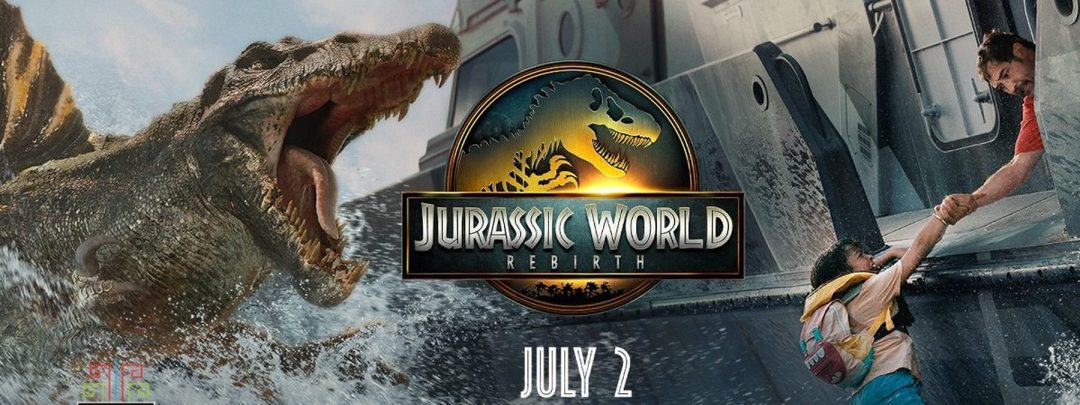
This article expands on my viral X thread analysing the Spinosaurus behaviour sequence in Jurassic World: Rebirth. Here, I break down why the scene fails from behavioural, ecological, and storytelling perspectives and how it could have been improved using evidence‑based palaeontology.
On February 22nd 2026 my X thread about the Spinosaurus sequence in Jurassic World Rebirth went viral. It reached more than 3.8 million views and drew over 300 comments. Many people asked for a clearer breakdown of the issues I raised, while others challenged the scientific basis of my critique. This article explains why the sequence fails from behavioural, ecological, and storytelling perspectives.
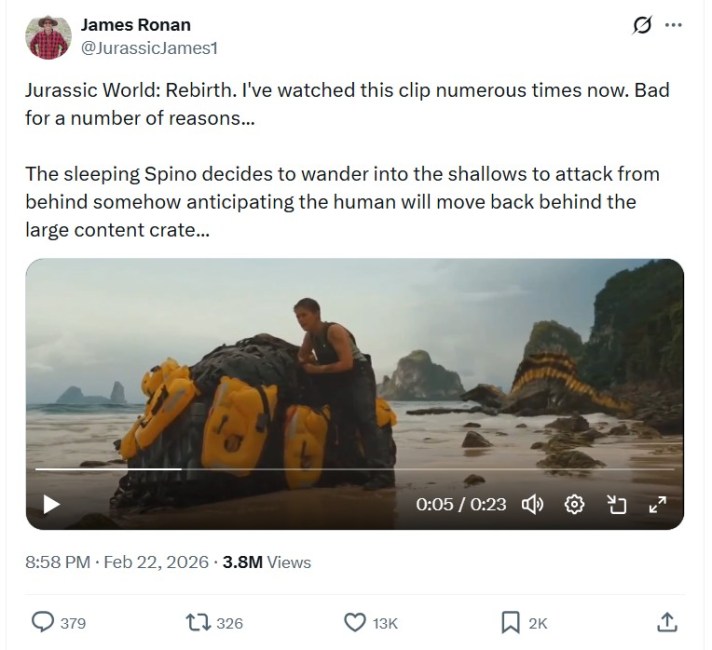
Will this satisfy the online Spinosaurus fans? Probably not. But I am writing this to explain my position in more detail than my original X thread allowed.
Why Scientific Critique Matters
Before addressing the scene, I want to clarify a point that came up repeatedly. Critiquing dinosaur behaviour in film and media is not “being part of the fun police.” It is part of what palaeontologists do. The fossil record gives us evidence for dinosaur locomotion, feeding strategies, predator–prey dynamics, intraspecies fighting, pathologies, parental behaviour, biomechanics, and ecology. We also compare dinosaur fossil data with the behaviour of their closest living relatives, birds, and crocodilians to build scientifically grounded interpretations.
There is nothing wrong with analysing a dinosaur film and pointing out what works and what does not, things that are excellent or things to improve. You can disagree with my conclusions but dismissing the science behind them is not reasonable. Palaeobiology, the fossil record, and extant animal behaviour all play major roles in these assessments. When I critique a palaeontological depiction I base it on fossil evidence, the scientific literature and extant analogues.
When I mentioned that I might publish this article in my newsletter, The Palaeo Minute, one person claimed I was withholding information behind a paywall and that “science is not like that because lecturers tell you the facts.” Lecturers share information, but most research is published in academic journals behind paywalls. Many palaeontologists also publish books, and these are not free either. Scientific work and expertise are not always free to produce or distribute. Anyway, I digress.
Several people also claimed in the X thread that Spinosaurus “would act like that because it is basically a crocodile.” It is not. Spinosaurus was a theropod dinosaur. Biomechanical studies show Spinosaurus rostrum were poorly suited to crocodilian-style torsional feeding (death roll), undermining the idea that it would behave like a crocodile in this scenario (Cuff and Rayfield, 2013). Although it had semi‑aquatic habits, its anatomy, posture, and predation strategy were different from those of crocodilians (Smart and Sakamoto, 2024).
Recent discoveries such as Spinosaurus mirabilis, with its distinctive scimitar‑like cranial crest likely used for display, highlight how diverse and specialised spinosaurids were, and how despite some superficial convergent similarities they were fundamentally far removed from crocodilian anatomy and behaviour (Sereno et al. 2026).
Problems With the Reconstruction
This leads to a broader issue. The reconstruction of Spinosaurus in Jurassic World: Rebirth is simply inaccurate. The film shows it as a sprawling quadruped that moves close to the ground. Fossil evidence supports a bipedal posture with hindlimbs capable of supporting its weight on land, as shown in biomechanical assessments by (Henderson, 2018) and later reviews by (Hone and Holtz, 2021).
Spinosaurus was semi‑aquatic but its tall sail makes deep diving unlikely. It likely spent its time wading or swimming in shallow waterways while hunting fish and other aquatic prey, a view shared by many palaeontologists.
With that context in place, let us now look at the sequence.
Behavioural and Storytelling Issues in the Sequence
In my original thread I argued that the scene is poorly structured from both a behavioural and storytelling standpoint. The Spinosaurus wakes, wanders into the shallows, and only then notices Nina, who at that moment is facing away from the animal. From a predatory perspective the ideal time to strike was on the beach, when the prey is unaware, close, and directly ahead.
Instead, the dinosaur moves past her circles behind the supply bag, and enters deeper water. Nina keeps facing the beach until she steps behind the bag. Because the audience cannot see what the Spinosaurus sees, we are meant to assume it is tracking her from behind. Yet the dinosaur chooses a longer and more energy‑heavy route. It enters the water, swims around and then emerges again to attack a target that was already vulnerable.
A crocodile might circle a target in the water to probe for weakness or create confusion, but a Spinosaurus in the Jurassic World franchise gains nothing by performing this wide looping manoeuvre. Its anatomy and inferred ecology favour direct, energy‑efficient strikes and the animal already had a clear advantage from the beach side. The circular approach shown in the film therefore feels biologically inconsistent and dramatically unnecessary.
Why the Attack Logic Fails
From what the film shows us it notices her when it is already in the water, while Nina’s back is to it and she is facing the audience. So how is the dinosaur anticipating her movement at all? It does not know Nina is going to move behind the supply bag. For all the animal knows she could step forward toward the group. Nina also has a slight advantage by already being on land while the Spinosaurus has gone back into the shallows, which is more ground to cover than the original position it was in.
This circling behaviour makes little environmental sense. Predators conserve energy and exploit the most efficient opportunities (Dececchi et al. 2020). The Spinosaurus had a perfect attack position on land, yet the scene forces it into a convoluted path for dramatic effect. The result feels telegraphed rather than tense. The only surprise is the reveal of the yellow stripe along its body, not the attack itself. The audience already knows what is about to happen, there is no tension or uncertainty.
Previous Jurassic films have mostly handled predatory sequences with strong situational logic. The animal’s behaviour aligns with its ecological role, the environment shapes the encounter and the attack unfolds in a way that feels both cinematic and biologically plausible. The Spinosaurus and Nina sequence does none of this. It undermines the creature’s intelligence, wastes the animal’s energy, and ignores the behavioural cues we would expect from a semi‑aquatic theropod.
How the Scene Could Have Worked
There were many ways the scene could have been improved. Imagine the attack from the beach side where the animal already had the advantage. The Spinosaurus rushes her and before she has time to react it is already too late. Or the sequence could have taken place with the Spinosaurus already standing in the shallows catching fish, before noticing Nina and approaching her from behind.
Imagine the scene playing out as Nina pulls the supply bag out of the sea. The Spinosaurus approaches from behind the bag. Nina uses her whole body weight to pull the bag back and as she starts to drag it she leans further back, slipping and sliding in the sand. She does not notice the dinosaur closing in on her until a large shadow blocks her view in the harsh sun; suddenly the jaws of the animal clamp down on her. She screams in pain and is carried away while Zora’s team scramble.
Or imagine two Spinosaurs approaching from the sides around the bag and cutting off Nina’s escape, creating real danger and urgency. Any of these options would have created tension while staying consistent with palaeobiology and environmental setup. The scene in the film lacks any tension, practical setup, and is clearly designed with a PG rating in mind. The attack is barely shown, hidden behind the bag as Nina clings on for her life. It is a very sanitised Jurassic World death scene, unlike the previous films in the series.
A Missed Opportunity
As it stands, the sequence is a missed opportunity. It overlooks key aspects of the fossil record, presents Spinosaurus with inaccurate posture and movement, and relies on behaviour that does not align with what we know about the animal. The result is a moment that feels dramatically flat and biologically implausible. As part of my consultancy work, I advocate for realistic, evidence‑based portrayals of prehistoric animals and moments like this show how easily accuracy can be lost in the final creative process and why it matters.
Scientific consultants advise rather than dictate creative decisions and inaccuracies often arise during production, editing, or rating constraints rather than from the science itself. Moments like this highlight why good consultancy matters: evidence‑based guidance helps filmmakers strengthen both realism and storytelling even if not every recommendation reaches the final cut.
If you are developing a creature sequence and want scientifically grounded behaviour, anatomy, and ecological logic that strengthens your storytelling, feel free to get in touch.
References
Header image is Jurassic World: Rebirth Spinosaurus poster. Image credit: Universal Pictures, 2025.

