These case studies provide illustrative examples of the types of issues identified during a Dinosaur Accuracy Audit. Dinosaur Accuracy Audits are suitable for museums, theme parks, travelling exhibitions, and animatronic manufacturers.
These case studies are anonymised, non‑exhaustive demonstrations designed to show how anatomical, environmental, interpretative, and experiential factors are assessed during the audit process. Each example highlights observed issues and recommended corrections to help organisations understand the structure and value of the audit.
Case Study: Accuracy Review of a UK Dinosaur Exhibit (Anonymised)
This case study is illustrative and highlights example issues the audit identifies. It is not intended as a complete assessment of the exhibit.
Overview
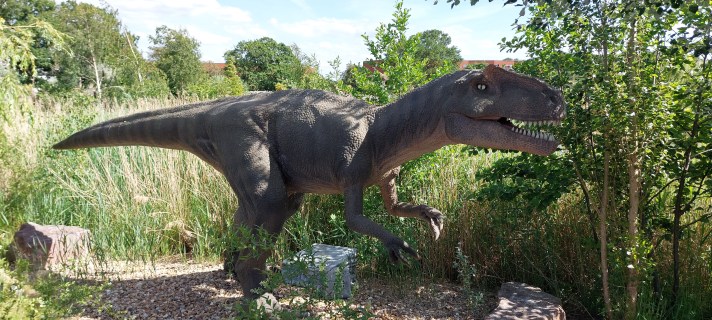
In April 2026, I conducted an observational accuracy review of a public dinosaur exhibit featuring a large theropod reconstruction. The aim was to demonstrate how the Dinosaur Accuracy Audit identifies outdated or incorrect anatomical and interpretive elements.
Observed Issues
- Static posture – The animatronic is posed in a neutral, non‑dynamic stance limiting how effectively it conveys behaviour or narrative intent.
- Lack of contextual placement – The dinosaur is presented without environmental or behavioural cues, reducing clarity around its ecological or interpretive context.
- Ecological mismatch – Surrounding vegetation includes wheat‑like long grass and modern deciduous plants, which did not exist during the Late Jurassic period.
- Visible sound system – The speaker used for sound effects is positioned directly beneath the animatronic, reducing immersion and drawing attention away from the model.
- Signage accuracy – Interpretive signage presents a modern-day “link” to a limbless reptile as factual, despite no direct evolutionary relationship between the species.
Recommended Corrections
- Dynamic posing – Depict feeding behaviour, consider placing a dinosaur carcass beneath the animatronic and adding subtle colouring to the teeth to imply recent feeding activity.
- Environmental alignment – Reposition the model away from modern vegetation or introduce a Late Jurassic‑themed palaeoart backdrop to create accurate ecological context.
- Visitor immersion – Relocate or conceal the sound system so audio effects originate from an unobtrusive location and not distract from the animatronic.
- Signage clarity – Signage should avoid equating dinosaurs with modern “link” animals that are not part of their evolutionary lineage, as this reduces scientific accuracy and confuses visitors.
Case Study: Dinosaur Model at a Crazy Golf Attraction (Anonymised)
This case study is illustrative and highlights example issues the audit identifies. It is not intended as a complete assessment of the exhibit.
Overview
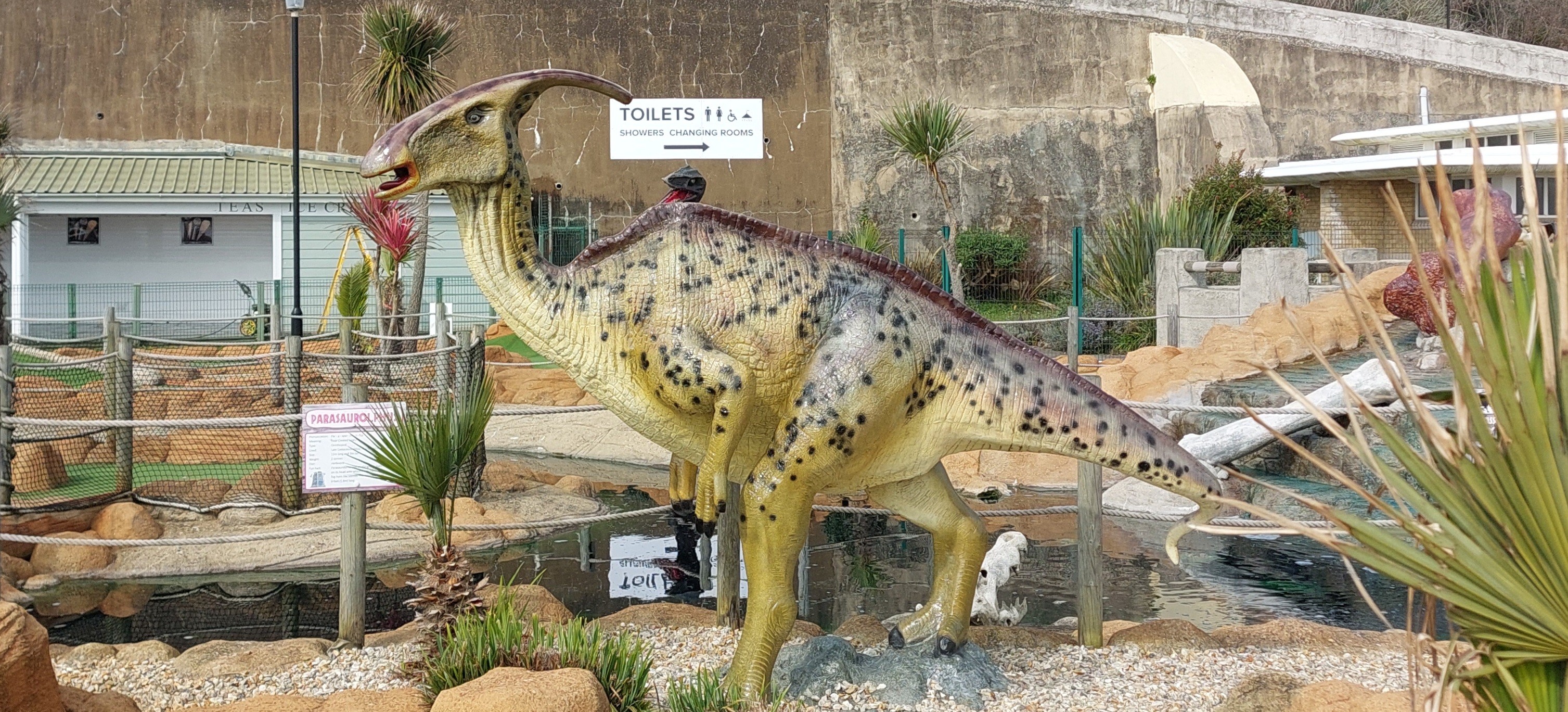
In March 2026, I conducted an observational accuracy review of a hadrosaur reconstruction at a Crazy Golf attraction featuring an array of dinosaurs. The aim was to demonstrate how the Dinosaur Accuracy Audit identifies outdated or incorrect anatomical and interpretive elements.
Observed Issues
- Model form – The Parasaurolophus appears highly shrink‑wrapped, with musculature and soft tissue reduced to a minimal silhouette.
- Body style – The overall body shape resembles older stylised interpretations, with reduced neck and cranial mass.
- Shrink‑wrapping – The skin is tightly contoured over the skull, creating an emaciated appearance inconsistent with modern reconstructions.
- Storytelling context – The model stands on a rock, but the intended behaviour or narrative is unclear, and the pose lacks interpretive context.
- Crest morphology – The crest is thin and directed backward/downward, differing from fossil evidence for Parasaurolophus walkeri, where it is more robust and sweeps upward.
- Lighting and visibility – The model is visually prominent during daytime, but low illumination reduces visibility and visitor engagement at night.
- Placement within attraction – As the only hadrosaur in the crazy golf course, it appears isolated, lacking environmental or interpretive elements that support its ecological context.
Recommended Corrections
- Soft‑tissue restoration – Increase musculature and soft‑tissue volume around the neck, skull, and torso to better reflect current hadrosaur anatomy.
- Pose clarity – Adjust the pose or add environmental cues (vegetation, terrain features) to clarify intended behaviour or narrative.
- Storytelling enhancement – Introduce clearer behavioural or narrative cues (feeding, alert posture, movement direction) or add environmental storytelling elements.
- Crest accuracy – Modify crest thickness and orientation to match fossil evidence for P. walkeri, with a more robust, upward‑sweeping arc.
- Lighting improvements – Enhance night time illumination to maintain visibility and engagement during evening visits.
- Contextual placement – Add hadrosaur‑related elements (juveniles, nests, footprints) or more visibly placed interpretive signage to provide ecological context and reduce isolation.
Interested in improving the scientific accuracy of your dinosaur attraction or exhibition? I provide Dinosaur Accuracy Audits for museums, theme parks, zoos, and visitor attractions worldwide.
Get in touch to discuss your project.

You must be logged in to post a comment.