The Dinosaur Accuracy Audit is the world’s first formal scientific‑accuracy standard for dinosaur attractions, exhibitions, and animatronics.
The Dinosaur Accuracy Audit is a structured evidence‑based accreditation system assessing scientific realism in dinosaur exhibitions, animatronics, and themed environments. It combines species‑level anatomical review, environmental accuracy, narrative clarity, and guest‑experience evaluation into a single professional benchmark.
About the Auditor
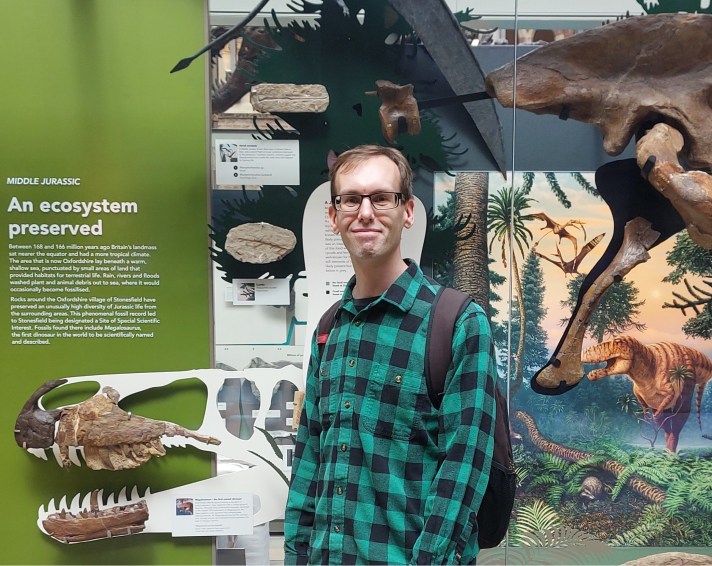
I personally conduct every Dinosaur Accuracy Audit. I am a vertebrate palaeontologist specialising in Mesozoic life and ecosystems, including dinosaur species, anatomy, behaviour, and palaeoenvironments. My background spans scientific consultancy, academic research, fieldwork, and public engagement. My expertise in dinosaur accuracy has also been consulted by national media, including The Times. I work with museums, theme park attractions, and creative teams to bring scientifically accurate dinosaurs to life.
Featured by national and international media

Public‑facing dinosaur exhibits often suffer from inconsistent or outdated portrayals, largely because no formal scientific‑accuracy standard has existed.
The Dinosaur Accuracy Audit changes all that
The Dinosaur Accuracy Audit establishes a clear professional benchmark for anatomical realism, behavioural plausibility and environmental coherence. By grounding each assessment in fossil evidence and current palaeontological research, the audit ensures that dinosaur‑themed experiences remain scientifically credible, anatomically accurate, and narratively coherent. It is the first structured scientific‑accuracy assessment designed specifically for dinosaur attractions and exhibitions.
- Objective accuracy assessment grounded in current palaeontology
- Clear scoring and certification for measurable realism
- Scientifically credible and financially efficient improvements to animatronics and environments
This audit combines modern palaeontology with practical quality control to minimise financial risk and maximise long‑term value.
A scientifically accurate dinosaur is not just a design choice. It is a responsibility.
Why Scientific Accuracy Matters
Having experienced many theme parks, museums, and dinosaur attractions myself, I created this audit to support and improve dinosaur exhibitions and themed environments, making them more scientifically accurate, more engaging, and more memorable for the public to experience.
Scientific accuracy strengthens every aspect of a dinosaur attraction. Realistic anatomy, behaviour, and environments create deeper immersion, enhance educational value, and elevate the overall quality of the experience. Whether you are developing an animatronic, a themed environment, or a full exhibition, accuracy helps audiences connect more meaningfully with the prehistoric world. Accurate reconstructions also reduce the risk of costly redesigns to animatronics, models, and environments, ensuring long‑term reliability and preventing expensive corrections later in development.
The Dinosaur Accuracy Audit has the potential to become the industry standard, a universal benchmark for scientific realism in dinosaur attractions, exhibitions, and animatronics.
The benchmark is now established
Who Is This Audit For
The Audit is designed for theme parks, museums, animatronic manufacturers, travelling exhibitions, exhibition designers, and creative teams who want scientifically credible dinosaurs and immersive prehistoric environments. This audit is designed to raise all ships, providing a clear supportive methodology that helps every attraction achieve higher scientific accuracy and stronger public trust.
What You Receive
Deliverables
You will receive a comprehensive Dinosaur Accuracy Audit report tailored to your attraction or exhibition. This includes:
- A detailed written assessment covering environmental accuracy, ecosystem coherence, guest experience, immersion, and visual/narrative clarity.
- Dinosaur species‑level accuracy evaluations (Appendix A), including anatomical realism, behavioural plausibility, and ecological alignment for each dinosaur.
- Annotated images highlighting areas of scientific inaccuracy and recommended corrections.
- A Weighted Accuracy Score calculated using the formal audit criteria.
- A formal digital certificate (PDF) confirming your Dinosaur Accuracy Score and certification level.
- Your certification level (Gold, Silver, or Bronze) with digital badges.
- A summary of recommended next steps for improving scientific realism within your attraction.
- The Certification Manifest: a formal list of all prehistoric assets included under the accreditation, defining the certified scope of the attraction.
Scope of the Audit
The Audit covers the entire attraction or exhibit and includes accuracy reviews for all species present. Species‑specific accuracy blocks are provided in a dedicated appendix to ensure clarity and efficiency for multi‑species installations.
Appendix A – Species Accuracy Assessments contain the full species‑level accuracy evaluations for every dinosaur present within the attraction. Each species is assessed individually to ensure anatomical realism, behavioural plausibility, and ecological alignment.
Most dinosaur reconstructions involve degrees of uncertainty due to gaps in the fossil record, variation within species, and evolving scientific interpretations. The Audit evaluates accuracy within these known limits and uses the most current evidence‑based research available.
Each species block includes:
- Species identification and time‑period alignment
- Anatomical accuracy (skull shape, limb proportions, posture, soft tissue, integument, colouration)
- Behavioural realism (movement, feeding mechanics, social behaviour, environmental interaction)
- Species‑specific visual annotations (where scientifically necessary)
- Individual species accuracy rating (1–10)
All species ratings are averaged to produce a single Species Accuracy Score, which contributes 40% of the final Dinosaur Accuracy Score. This structure allows multi‑species attractions to be evaluated clearly and consistently without inflating the main audit document.
Optional Species Extensions
This assessment evaluates the scientific accuracy of dinosaur species and their associated prehistoric environments. Pterosaurs and marine reptiles (Plesiosauria, Ichthyosauria, Mosasauridae) are not dinosaurs and are not included by default, but can be assessed as an optional extension upon request. These extensions apply the same scientific accuracy framework as the core audit and are offered as additional, modular services that can be added to any project if required.
What the Audit Evaluates
1. Initial Project Overview
A brief outline of the audit’s purpose, the attraction or scene being evaluated, its narrative intent, and the audience and experience it is designed for. This ensures the evaluation aligns with your creative direction and operational needs.
2. Environmental & Ecosystem Review
Assessment of the surrounding habitat and ecological storytelling:
Habitat Alignment
- Geological period
- Climate plausibility
- Terrain accuracy
Vegetation Accuracy
- Plant species plausibility
- Density and arrangement
- Ecosystem coherence
Ecosystem Interactions
- Predator–prey relationships
- Herd or social behaviours
- Environmental storytelling clarity
3. Guest Experience & Immersion Review
Analysis of how effectively the scene communicates realism and narrative to guests. This includes the following:
Sightline Analysis
- First view impact
- Visibility of key anatomical features
- Avoidance of immersion‑breaking elements
Narrative Clarity
- Coherent storytelling
- Behaviour alignment with intended narrative
Emotional Engagement
- Awe, tension, curiosity, or wonder moments
- Opportunities for deeper guest connection
Safety & Realism Balance
- Realistic but safe posture/behaviour
- Guest proximity considerations
4. Recommendations
A prioritised list of improvements is provided:
High Impact Improvements
Major enhancements to realism or immersion.
Medium Impact Improvements
Refinements that strengthen accuracy or narrative clarity.
Low Impact Optional Enhancements
Minor adjustments that add polish or depth.
5. Visual Annotations
Annotated images highlight specific adjustments, biomechanical corrections, environmental cues, and sightline improvements.
Suggested annotation labels include:
- Posture adjustment for biomechanical accuracy
- Environmental cue to reinforce habitat
- Behavioural alignment with species ecology
- Guest sightline optimisation
6. Summary & Next Steps
The audit concludes with a summary of what has been identified and the overall accuracy score:
Overall Accuracy Score
The Overall Accuracy Score provides a clear measurable indication of how scientifically realistic a dinosaur theme park attraction or animatronic exhibition is. The score is calculated using a weighted assessment across the four core areas:
Accuracy Scoring Criteria
Species Accuracy – Anatomical realism, behavioural plausibility, and ecological alignment for each species (Appendix A).
Environmental & Ecosystem Accuracy – Habitat alignment, vegetation plausibility, and overall ecological coherence across the attraction.
Guest Experience & Immersion – Sightlines, narrative clarity, emotional engagement, and how well the experience supports believable prehistoric storytelling.
Visual & Narrative Clarity – Visual consistency, layout readability, and how clearly the intended story and scientific context are communicated.
Species Accuracy (40%) is calculated using the detailed species assessments provided in Appendix A.
Each area contributes to the final score out of 100, offering a straightforward benchmark that attractions can use for development, comparison, and future improvement.
This score also determines the Accuracy Certification Level awarded at the end of the audit.
Accuracy Certification Levels
A digital certificate confirming the attraction’s Dinosaur Accuracy Score and certification level will be issued as part of the accreditation.
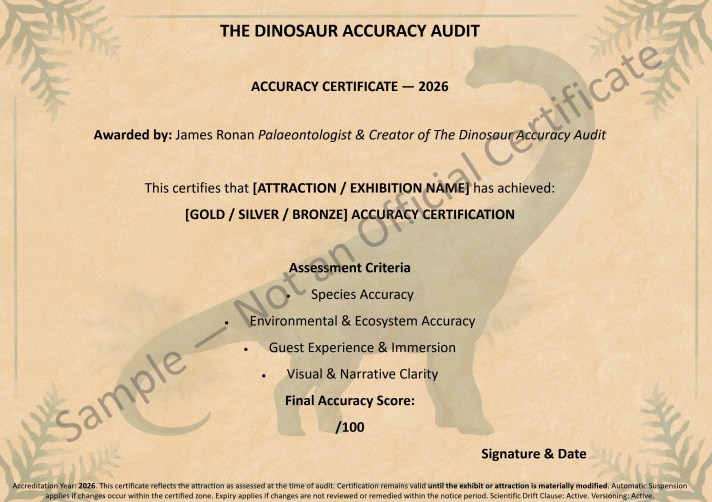
Attractions receive an official Accuracy Certification Level, recognising the degree of scientific realism achieved across species accuracy, environmental coherence, guest immersion, and visual/narrative clarity.
Gold Accuracy Certification
85-100
Exemplary scientific accuracy. Awarded to attractions demonstrating outstanding species realism, coherent environmental design, strong guest immersion, and clear visual/narrative communication.
Silver Accuracy Certification
70-84
Strong scientific accuracy with minor refinements recommended. Awarded to attractions presenting highly plausible species accuracy, environmental alignment, and immersive storytelling, with only small improvements suggested.
Bronze Accuracy Certification
50-69
Baseline scientific plausibility with several areas for improvement. Awarded to attractions that meet foundational standards of species accuracy and environmental coherence but require further refinement to enhance realism and immersion.
Uncertified (0–49)
Does not meet baseline scientific plausibility. Indicates significant anatomical, ecological, or behavioural inaccuracies that prevent certification. Attractions in this range require revision before they can achieve Bronze status. Uncertified attractions are not eligible for publication, listing or badge display within the Dinosaur Accuracy Audit until they meet baseline scientific plausibility.
These certification levels provide a robust standardised measure of scientific accuracy across attractions.
Certification QR Code
Certified attractions and exhibits receive a unique QR code linked to the official accreditation registry. This QR code may be displayed on‑site, on signage, exhibit panels, entrance boards, and approved marketing materials. It verifies the attraction’s certification level and the specific assets listed in the Certification Manifest. QR codes are part of the protected Dinosaur Accuracy Audit framework and may only be used in accordance with the Certification Badge Publication Terms.
Certification Maintenance
Manifest B
Dinosaur Accuracy Accreditation applies only to the specific assets evaluated during the audit and listed in the Certification Manifest. Accreditation reflects accuracy at the time of audit and does not extend to any new, modified, or replaced prehistoric assets added to the certified zone after the audit is complete.
Any changes to certified models, movement programming, environmental storytelling, or exhibit composition must be reviewed to maintain accreditation. If un‑audited assets are introduced, certification for the affected zone is automatically suspended until a review is completed. Clients are responsible for contacting me regarding any updates they wish to include under the accreditation.
Suggested Follow‑Up Consultancy Services
- Behavioural motion guidance
- Environmental worldbuilding
- Attraction narrative refinement
- Scientific creature accuracy refinement (non-illustrative)
Sample Audit
See a structured example of the Dinosaur Accuracy Audit used for attractions and exhibitions.
You can view anonymised real‑world examples of the Dinosaur Accuracy Audit in practice on the Audit Case Studies page.
Project Fees & On-Site Costs
All projects begin at a minimum project fee of £10,000. Which covers onboarding and the initial scientific review.
The Dinosaur Accuracy Audit carries a separate fee, calculated according to the number of models or animatronics, movement complexity, environmental storytelling requirements, guest walkthrough design, outdoor installations and any relevant IP considerations.
On-Site Requirements
The Dinosaur Accuracy Audit requires an in‑person site visit to assess models, animatronics, environments, and guest flow. On‑site days, travel, accommodation, and expenses are added in addition to the audit fee.
The Dinosaur Accuracy Audit fee is not publicly listed. It is quoted privately on a per‑project basis following review of your attraction’s scope before the initial scientific review. Additional audit pathways exist for early‑phase scientific review, recognition partners, and mid‑tier certification. These are outlined privately during consultation.
Apply for the Founder Audit Programme
The UK Founder Audit Programme is now open for a one‑time launch. Only three organisations will be accepted, and each one will receive a reduced‑rate Founder Audit and the one‑time Founder Accreditation. If your organisation wishes to secure one of the three Founder Partner slots, you are encouraged to apply during the August–December 2026 window before the category closes permanently.
Questions About How I Work?
These answers cover the practical details clients often want to know before booking an accuracy audit.
Expand to read the Frequently Asked Questions (FAQs)
FAQs
What is a Dinosaur Accuracy Audit?
A Dinosaur Accuracy Audit is a structured evaluation of how scientifically accurate an attraction’s dinosaurs, environments, and behaviours are. It assesses anatomy, movement, ecology, environmental design, and guest immersion to identify high‑impact improvements.
Who is the Audit for?
The Audit is designed for theme‑parks, museums, animatronic manufacturers, travelling exhibitions, exhibition designers, and creative teams who want scientifically credible dinosaurs and immersive prehistoric environments.
What does the Audit include?
A full Audit includes:
- Species‑level accuracy assessments (Appendix A)
- Environmental & ecosystem accuracy review
- Guest experience & immersion analysis
- Visual annotations
- Weighted Dinosaur Accuracy Score
- Certification level (Gold, Silver, Bronze)
- High‑impact recommendations
Streamlined (reduced‑scope) Audits are also available for organisations seeking a lighter option, following the same evidence‑based framework with a condensed assessment.
How long does an Audit take?
Most Dinosaur Accuracy Audits take 3–5 hours of structured on‑site evaluation for attractions with multiple animatronics. Larger or more complex installations may require additional time. The final written report and certification are prepared after the on‑site assessment.
Do you visit the attraction in person?
Yes. Full and Streamlined Audits are conducted on‑site to accurately assess posture, movement, sightlines, environmental cues, and guest experience.
What is Appendix A?
Appendix A contains the species‑specific accuracy assessments. Each dinosaur receives a concise evaluation covering:
- Species identification
- Anatomical realism
- Behavioural plausibility
- Ecological alignment
- A 1–10 accuracy rating
These ratings form 40% of the final Dinosaur Accuracy Score.
How is the final score calculated?
The final score is based on four weighted components:
- Species Accuracy – 40%
- Environmental & Ecosystem Accuracy – 25%
- Guest Experience & Immersion – 25%
- Visual & Narrative Clarity -10%
The weighted total determines the certification level.
What do the certification levels mean?
Gold – Exemplary scientific accuracy across anatomy, behaviour, environment, and immersion.
Silver – Strong accuracy with minor refinements recommended.
Bronze – Baseline plausibility with several areas for improvement.
Uncertified (0–49) – Does not meet baseline scientific plausibility.
Do you offer post‑audit support?
Yes. Post‑audit support is available as an optional retainer for clients who want scientific review of revised sculpts, updated animatronic movement, environmental adjustments, signage accuracy, marketing accuracy, or certification maintenance. Full details are provided in the project agreement.
Do you provide recommendations?
Yes. Every audit includes high, medium, and low‑impact recommendations to improve realism, narrative clarity, and guest immersion.
Can you help implement the recommendations?
Yes. Follow‑up consultancy services include:
- Behavioural motion guidance
- Environmental worldbuilding
- Narrative refinement
- Scientific creature accuracy refinement
- Palaeontological review for new installations
Do you Audit pterosaurs and marine reptiles?
Yes. Pterosaurs and marine reptiles (such as plesiosaurs, ichthyosaurs, and mosasaurs) can be included as optional extensions to the Dinosaur Accuracy Audit. They are assessed using the same structured anatomical, behavioural, and ecological criteria.
Are pterosaurs and marine reptiles included in the standard Audit?
Not automatically. The core Audit focuses on dinosaurs only. Pterosaurs and marine reptiles require additional anatomical and ecological analysis, so they are added as optional extensions on top of the base Audit fee.
Why are pterosaurs and marine reptiles optional?
They are not dinosaurs, and their anatomy, biomechanics, and habitats differ significantly. Evaluating them accurately requires:
- Specialised anatomical review
- Flight or aquatic biome analysis
- Additional environmental assessment
Do you Audit prehistoric mammals?
No. The Audit covers dinosaurs, with optional extensions for pterosaurs and marine reptiles. Prehistoric mammals are not part of the service.
Do you Audit synapsids and therapsids?
No. The Dinosaur Accuracy Audit focuses exclusively on dinosaurs with optional extensions for pterosaurs and marine reptiles. Synapsids and therapsids are not included in any audit or extension service.
Can the Audit be adapted for new installations or early concepts?
Yes. The Audit framework can be applied during early development to guide scientifically accurate creature design, environment planning, and narrative structure.
Do you need to be notified if an exhibit is changed or updated?
Yes. Any changes inside the certified zone must be reviewed to maintain certification.
What happens if a new dinosaur or animatronic is added?
New prehistoric assets must be reviewed before they can be included under the certification.
Will certification be suspended if changes are made without review?
Yes. Unauthorised changes automatically suspend certification until reviewed.
How do new assets get reviewed?
You may request a post‑audit support retainer or hourly review. This is treated as a change order review.
Do you monitor future changes to the attraction?
No. Certification reflects accuracy at the time of audit. The client is responsible for notifying me of the changes.
Will the public be able to see what was certified?
Yes. A simplified version of Manifest B will be available on the public accreditation registry as a downloadable PDF, allowing visitors to see exactly which assets were certified.
Can certification be revoked?
Yes. If changes are not remedied within the notice period, certification may be revoked and badge usage withdrawn.
Intellectual Property Notice
The Dinosaur Accuracy Audit™ brand name, framework, scoring system, rating methodology, certification levels, badges, digital certificates, audit reports, and all associated materials are proprietary assets of James Ronan. The Dinosaur Accuracy Audit™ is a trademark under pending registration (UK IPO), and all materials are protected by copyright.
These materials may not be reproduced, adapted, or applied to other projects without express written permission. Clients receiving a certification are granted a non‑exclusive licence to display the official badge solely for the specific attraction or exhibit audited.

You must be logged in to post a comment.