Gryposaurus monumentensis

The above profile for Gryposaurus monumentensis outlines its temporal range, fossil location, skull description, and details of the Kaiparowits Formation, where it was discovered. Additional palaeontological research and references are provided below.

Gryposaurus monumentensis skull with scale bar from the Utah Museum of Natural History. Image credit: Science 2.0, 2024.

Gryposaurus monumentensis was a saurolophine hadrosaurid which lived throughout the Late Cretaceous from 83.5 to 70.6 million years ago. Gryposaurus was a social dinosaur and was capable of moving both bipedally and quadrupedally.

This dinosaur like other hadrosaurids was a herbivore and its dental battery was packed full of hundreds of teeth, perfect for slicing through tough plant matter. Gryposausus had replacement teeth, waiting to be used and these sustained the dinosaur’s browsing on fibrous plant vegetation over its lifetime.

Gryposaurus monumentensis has seen a fair amount of palaeontological research since its announcement in 2007. Research has covered its palaeobiology, cranial development, and phylogeny. The 2007 research paper by Gates and Sampson examined the anatomy of Gryposaurus monumentensis through comparison with other Gryposaurus species.

Gryposaurus monumentensis was identified to have distinguished features such as more robust skull and jaws, including a smaller infratemporal fenestra. Other unique morphologies included the large prongs on the margin of the predentary and a median flange on the surangular.

Lateral view of Gryposaurus monumentensis (RAM 6797) left premaxilla with scale bar at 5 cm. Image credit: Gates and Sampson, 2007.

The research observed the biostratigraphy of where the Gryposaurus remains had been found with Gryposaurus monumentensis only known from the middle unit of the Kaiparowits Formation.

A faunal turnover of the species in the southern part of the Western Interior Basin during the Late Cretaceous was suggested as four Gryposaurus species have been identified across the USA and Canada. These species cover over five million years of geological time from 80 to 74.5 million years ago with extensive geographic range (over 2,000 km), one of the largest within dinosaur genera.

There has been much research into the stratigraphy and palaeo fauna of the Kaiparowits Formation where Gryposaurus remains have been located. The dinosaur shared its environment with a number of dinosaur taxa such as the tyrannosaurid Teratophoneus curriei, ceratopsians like Nasutoceratops titusi and Kosmoceratops richardsoni and other duck-billed dinosaurs like Parasaurolophus cyrtocristatus. There were a host of other non-avian dinosaurs that occupied the Kaiparowits Formation during this time as well.

The palaeoenvironment during the Late Cretaceous was incredibly rich and biodiverse supporting a wide range of species. Fossilised remains for a wealth of other wildlife have also been recognised within the geological formation from chondrichthyans (cartilaginous fishes such as sharks and rays) to amphibians, turtles, and crocodilians. Palaeoenvironment studies have enabled further insight into the life of Gryposaurus monumentensis and the palaeo fauna it lived alongside.

I hope this profile and article on Gryposaurus monumentensis has been insightful and provided a good breakdown of its palaeobiology and life history. There is a lot of palaeontological information which has been retrieved from Gryposaurus since its discovery in 2007 and continued research should provide more insight into the species development of saurolophine hadrosaurids.

Enjoyed this post? Support my science outreach.

cards
Powered by paypal

References

Gryposaurus monumentensis skeletal by Dr. Scott Hartman skeletaldrawing.com.

Dinosaur silhouettes from Phylopic.org by Dr. Scott Hartman and used under the Attribution-NonCommercial-Sharealike 3.0 Unported license.
 1. Gates, T. & Sampson, S. (2007) A new species of Gryposaurus (Dinosauria: Hadrosauridae) from the late Campanian Kaiparowits Formation, southern Utah, USA. Zoological Journal of the Linnean Society. 151, (2) p. 351-354

Roberts, E., Deino, A., & Chan, M. (2005) 40Ar/39Ar age of the Kaiparowits Formation, southern Utah, and correlation of contemporaneous Campanian strata and vertebrate faunas along the margin of the Western Interior Basin. Cretaceous Research. 26, (2) p. 308

Hypacrosaurus stebingeri

The above profile for Hypacrosaurus stebingeri covers its temporal range, fossil location, embryonic development, and cranial research, with additional palaeontological information and references provided below.

Hypacrosaurus stebingeri was a large lambeosaurine hadrosaurid that lived throughout the Late Cretaceous 83.5 to 72.1 million years ago. Hypacrosaurus stebingeri like other lambeosaurine dinosaurs was a herbivore and capable of moving bipedally or quadrupedally.

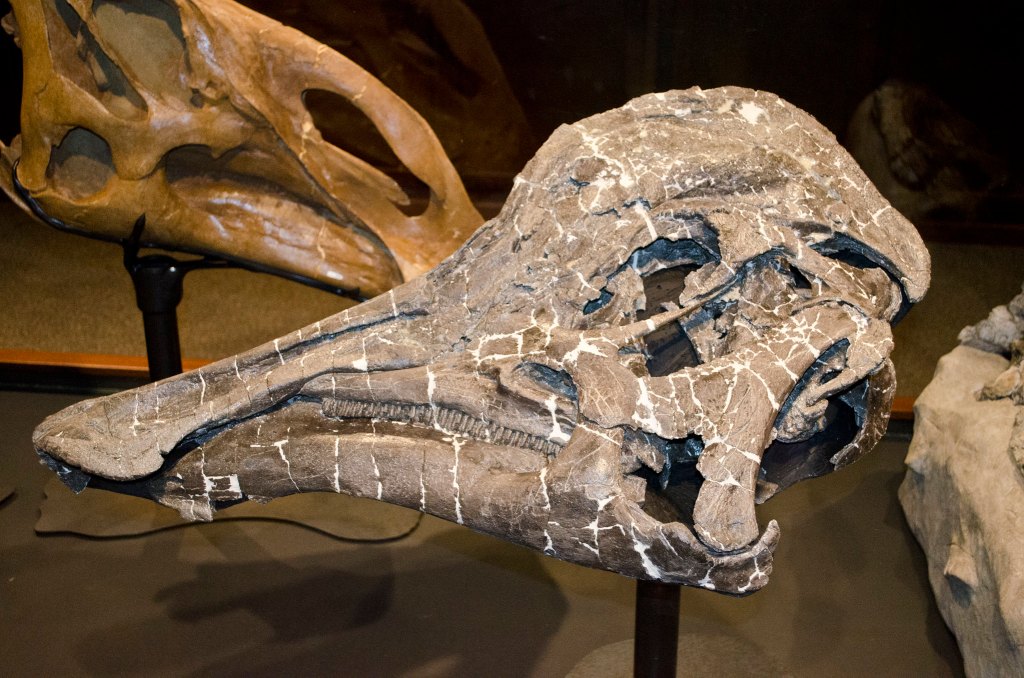
Hypacrosaurus stebingeri holotype specimen (MOR 549) skull on display at the Museum of the Rockies. Image credit: Tim Evanson, 2013.

Many nesting sites and juvenile egg clutches of Hypacrosaurus have been identified suggesting this dinosaur lived in herds and that it provided parental care for extended periods of time. Hypacrosaurus stebingeri remains have been identified in the Oldman Formation of Alberta Canada and the Two Medicine Formation of Montana USA.

Two species of Hypacrosaurus are known, Hypacrosaurus stebingeri which is the focus of this fact file and Hypacrosaurus altispinus. Hypacrosaurus altispinus was the first specimen discovered in 1910 by palaeontologist Barnum Brown in Alberta Canada, who identified the holotype (AMNH 5204). The holotype specimen of Hypacrosaurus stebingeri (MOR 549) pictured above was discovered in 1994, from Badger Creek in the Two Medicine Formation.

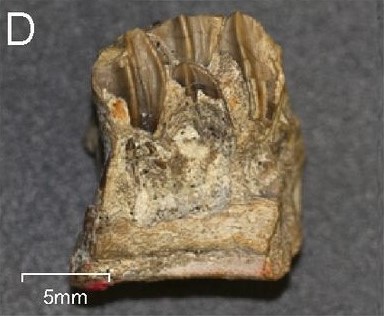
Hypacrosaurus has seen extensive palaeontological research since the 1990s covering its anatomy, jaw adductor mechanics, cellular preservation, and size-frequency distribution providing analysis of Hypacrosaurus palaeobiology and life history. The 2016 research paper by Erickson and co-authors examined nonavian dinosaur incubation periods, examining Von Ebner incremental lines in embryonic Hypacrosaurus teeth.

Hypacrosaurus stebingeri tooth section (D) displaying the functional teeth and those in development. Scale bar is 5 mm. Image credit: Erickson et al. 2016.

The fossil Hypacrosaurus embryos used in the study were recovered from nests in the fluvial out bank deposits within the Oldman Formation of Alberta. The Hypacrosaurus eggs had dimensions of 18.5 x 20cm with an estimated volume of 3,900 cc. The study identified daily forming growth lines within the embryonic teeth with slower embryonic development across months, more akin to embryonic development seen in extant (present day) reptilian embryos.

Diagram displaying the protocol for determining the incubation period and tooth replacement rate in Hypacrosaurus in the study. Image credit: Erickson et al. 2016.

As a result of the longer embryonic development times there were increased risks identified such as predation, starvation, and environmental factors which would have impacted the hadrosaurid eggs and parents. This research has enabled a deeper insight into Hypacrosaurus development and risks associated with increased incubation times throughout the Late Cretaceous.

I hope this profile and additional info on Hypacrosaurus stebingeri has been insightful and worth reading. New palaeontological research is providing a greater understanding of lambeosaurine hadrosaurids, you can learn more about other lambeosaurines like Lambeosaurus lambei here.

Enjoyed this post? Support my science outreach.

cards
Powered by paypal

References

Hypacrosaurus stebingeri skeletal by Dr. Scott Hartman skeletaldrawing.com.

Dinosaur silhouettes from Phylopic.org by Dmitry Bogdanov and used under the Attribution 3.0 Unported license.

1. Erickson, G., Zelenitsky, D., Kay, D., & Norell, M. (2016) Dinosaur incubation periods directly from growth-line counts in embryonic teeth show reptilian-grade development. Proceedings of the National Academy of Sciences. 114, (3) p. 540-545

2. Evans, D. (2010) Cranial anatomy and systematics of Hypacrosaurus altispinus, and a comparative analysis of skull growth in lambeosaurine hadrosaurids (Dinosauria: Ornithischia). Zoological Journal of the Linnean Society. 159, (2) p. 429

Mantellisaurus atherfieldensis

The above profile for Mantellisaurus atherfieldensis covers its temporal range, fossil location, initial discovery, and mandibular research, with additional palaeontological information and references provided below

The holotype specimen of Mantellisaurus atherfieldensis (NHMUK R5764) is on display in the Hintze Hall of the Natural History Museum in London. The holotype specimen was first discovered in 1914 on the Isle of Wight. Image credit: James Ronan, 2022.

Mantellisaurus atherfieldensis was a large iguanodontian dinosaur that lived throughout the Early Cretaceous between 136.4 and 125 million years ago. Mantellisaurus like other iguanodontian dinosaurs was an herbivore and was lightly built only weighing up to 750 kg.

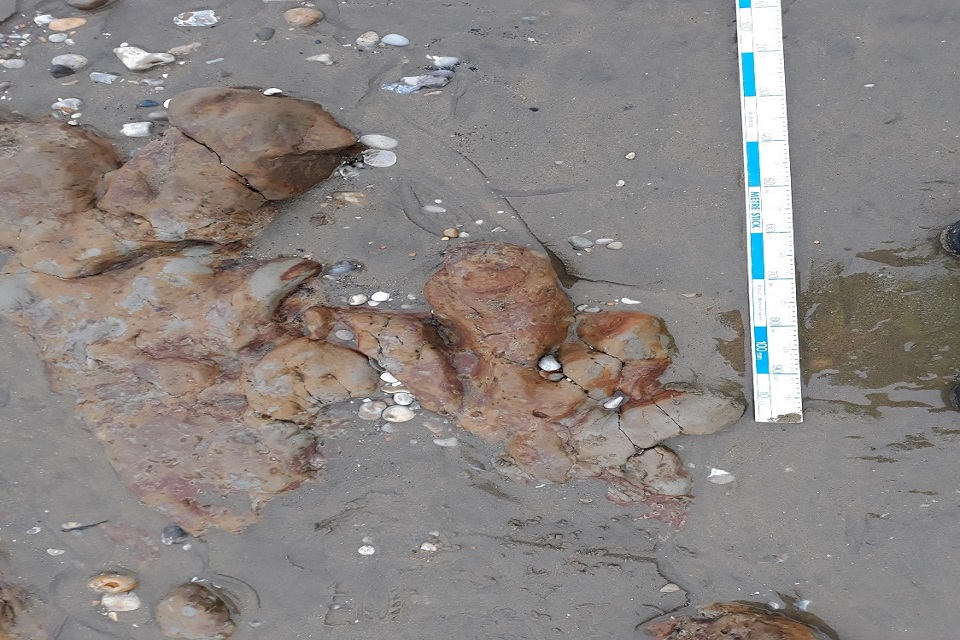
When compared to Iguanodon bernissartensis which weighed 5.0 tonnes, Mantellisaurus was much lighter in comparison. Mantellisaurus is considered to have been a quadrupedal dinosaur capable of also moving bipedally. Trace fossil footprints of the dinosaur have been identified at Yaverland on the Isle of Wight.

Mantellisaurus atherfieldensis tridactyl (three-toed) footprints identified in Yaverland on the Isle of Wight in 2023. Image credit: JBA Consulting/Environment Agency.

Mantellisaurus fossilised remains have been identified at the following geological formations; the Wealden and Wessex Formation of the United Kingdom, Sainte-Barbe Clays Formation in Belgium. The Calcaires à Spatangues, Argile Ostréenne, and Grès et Sables Piquetés Formations in France, the upper Barremian in Germany, and the Papo Seco Formation in Portugal. The La Huérguina, Camarillas, Arcillas de Morella, and Mirambel Formations in Spain.

Mantellisaurus atherfieldensis has seen a substantial amount of palaeontological research covering its bonebed occurrences, phylogeny, taxonomy, anatomy, and mandibular elements. The Mantellisaurus holotype (NHMUK R5764) on display in the Hintze Hall of the London Natural History Museum is 80-90% complete and was 3D scanned in 2019 to provide important data for palaeontological research.

You can check out this video below from the Natural History Museum where Dr Susannah Maidment explains the importance of scanning the bones of Mantellisaurus and how such research will increase scientific knowledge.

Dr Susannah Maidment and Dr Joe Bonsor talk about the importance of studying Mantellisaurus bones to understand the dinosaurs palaeobiology.

As a result of the 3D scanning work in the above video on the fossil, research was published in 2023 by Bonsor and co-authors covering Mantellisaurus atherfieldensis osteology and phylogenetic position.

The research identified Mantellisaurus as a valid taxon, distinct from the Iguanodon genus due to autapomorphies (distinct features) of the premaxilla, maxilla and the dinosaurs scapula. Such in-depth research is enabling a deeper insight into the evolutionary history of iguanodontian dinosaurs.

I hope this fact file and additional info on Mantellisaurus atherfieldensis has been insightful and worth reading. I have been working hard to improve the scicomm of the website across 2023 and this will be continuing across 2024.

The website has seen increased readership which has been fantastic to see, with the science communication tab and dinosaur profile tabs being immensely popular with new readers.

I highly recommend exploring all that the website has to offer to learn more about science communication and dinosaur palaeobiology.

Enjoyed this post? Support my science outreach.

cards
Powered by paypal

References

Dinosaur silhouettes from Phylopic.org by Matt Dempsey and used under the Attribution 3.0 Unported license.

1. Paul, G. (2008) A revised taxonomy of the iguanodont dinosaur genera and species. Cretaceous Research. 29 (2) p. 192

2. McDonald, A. (2012) The status of Dollodon and other basal iguanodonts (Dinosauria: Ornithischia) from the Lower Cretaceous of Europe. Cretaceous Research. 33 (1) p. 3

Brachylophosaurus canadensis

The above profile for Brachylophosaurus covers its temporal range, fossil location, preserved soft tissue remains, and stomach contents, with additional palaeontological research and references provided below

Brachylophosaurus canadensis was a saurolophine hadrosaurid that lived throughout the Late Cretaceous 83.5 to 72.1 million years ago. Brachylophosaurus was an active quadrupedal herbivore, a social dinosaur that lived in herds. The holotype specimen (NMC 8893) was first discovered in 1953 by palaeontologist Charles Mortram Sternberg in Alberta, Canada.

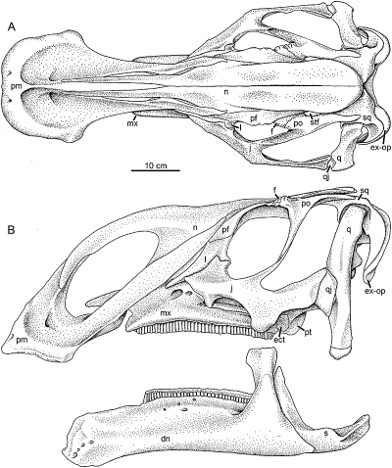
Reconstruction of the skull and lower dentary of the holotype specimen (NMC 8893) in dorsal (A) and lateral (B) views. The jaws were highly sophisticated and built to grind plant matter up with ease. Image credit: Cuthbertson and Holmes, 2010.

Brachylophosaurus remains have been recovered in the geological formations of the Judith River Formation in Montana, the Wahweap Formation in Utah USA, and the Oldman Formation in Alberta Canada.

Multiple Brachylophosaurus bonebed sites have been identified and there have also been a number of exquisitely preserved mummified specimens which have also been discovered. These beautifully preserved fossilised specimens provide soft tissue evidence including skin imprints and muscle tissue.

The most famous of these specimens is displayed in the above fact file, specimen (JRF 115) which was discovered in 2000 in Philips County in Malta, Montana. The fossil specimen is currently on loan from the Great Plains Dinosaur Museum of which it is housed to the Children’s Museum of Indianapolis.

Brachylophosaurus (JRF 115) is incredibly well preserved due to the dinosaur being buried within a fluvial channel system. The specimen displays a number of important biological and palaeontological features which include polygonal skin imprints that cover over 90% of the specimen, a heavily muscled neck, and an intact gut with digested plant matter contents.

Analysis of the Brachylophosaurus gut contents identified a diet of ferns, conifers, and leaves. The dinosaur used its highly developed jaws and teeth to breakdown tough vegetation enabling it to be able to browse and graze with ease. You can check out the video below where palaeontologist Dr. Robert Bakker gives an overview of the scientific evidence obtained from the mummified Brachylophosaurus specimen.

Palaeontologist Dr. Robert Bakker breaks down the scientific evidence obtained from Brachylophosaurus specimen (JRF 115) using a Brachylophosaurus model in this video from the Houston Museum of Natural Science.

The 2016 research paper by Tweet and co-authors examined the gut contents of Brachylophosaurus specimen (JRF 115) in further detail. The research observed two hundred and eighty trace fossils in the dinosaur’s gut region, from the parasite Parvitubulites striatus where burrows had been identified.

This exciting palaeontological evidence suggests that like many extant animals of today which carry parasites, dinosaurs were also prone to parasites as well. Revealing a fascinating aspect of the complexity of life within the Late Cretaceous dinosaur and ecological food web.

Brachylophosaurus has seen extensive palaeontological research covering its nasal crest, skull, diet, fossil preservation potential and evidence for tumour growth. This research has provided an in-depth examination of the hadrosaurids palaeobiology and the paleoenvironments it lived in, which has been integral in furthering our understanding of prehistoric history and the biology of dinosaurs.

I hope you have found this profile and examination of Brachylophosaurus canadensis intriguing. You can find out more about other saurolophine hadrosaurs like Edmontosaurus here.

The science communication tab and dinosaur profile tab have been immensely popular with new readers, and I recommend exploring all that the website has to offer.

Enjoyed this post? Support my science outreach.

cards
Powered by paypal

References

Brachylophosaurus canadensis skeletal by Dr. Scott Hartman skeletaldrawing.com.

Dinosaur silhouettes from Phylopic.org by Dr. Scott Hartman and used under the Attribution-NonCommercial-Sharealike 3.0 Unported license.

1. Tweet, J., Chin, K. & Ekdale, A. A. (2016) Trace fossils of possible parasites inside the gut contents of a hadrosaurid dinosaur, Upper Cretaceous Judith River Formation, Montana. Journal of Palaeontology. 90, (2) p. 279-287

Iguanodon bernissartensis

The above profile for Iguanodon bernissartensis covers its temporal range, fossil location, fossilised footprints, and thumb spike, with further details on its palaeontological history and references below.

Iguanodon bernisssartensis was a large iguanodontian dinosaur that lived throughout the Early Cretaceous. Iguanodon was a quadruped capable of moving on all fours. This dinosaur was capable of reaching sizes in excess of thirty feet and weighed up to five tonnes.

Iguanodon had an advanced jaw system using its beak to crop vegetation. It used its exceptional teeth to grind up vegetation into a palp to be swallowed. Iguanodon is considered to have been a low browser, feeding on Cretaceous angiosperms although it was able to reach vegetation at height. Iguanodons teeth were replaceable, and this enabled the dinosaur to continuously feed for the rest of its life, breaking down tough plant matter.

A reconstruction of an Iguanodon head at the University of Oxford Museum of Natural History. Image credit: James Ronan, 2019.

Palaeontologist and geologist Gideon Mantell named Iguanodon in 1825 and the dinosaur was one of the first dinosaurs to be described. Along with Megalosaurus and Hylaeosaurus, Iguanodon was one of three genera that British palaeontologist Sir Richard Owen based the clade Dinosauria on.

Fossilised remains of Iguanodon have been identified throughout Europe in the Wessex Formation of the United Kingdom, Sainte-Barbe Clays Formation in Belgium, Argile Ostréenne and Grès et Sables Piquetés Formation in France, and the Bückeberg Formation in Germany. In Spain Iguanodon remains have been identified in the Camarillas, Arcillas de Morella, Capas Rojas, and El Collado Formations.

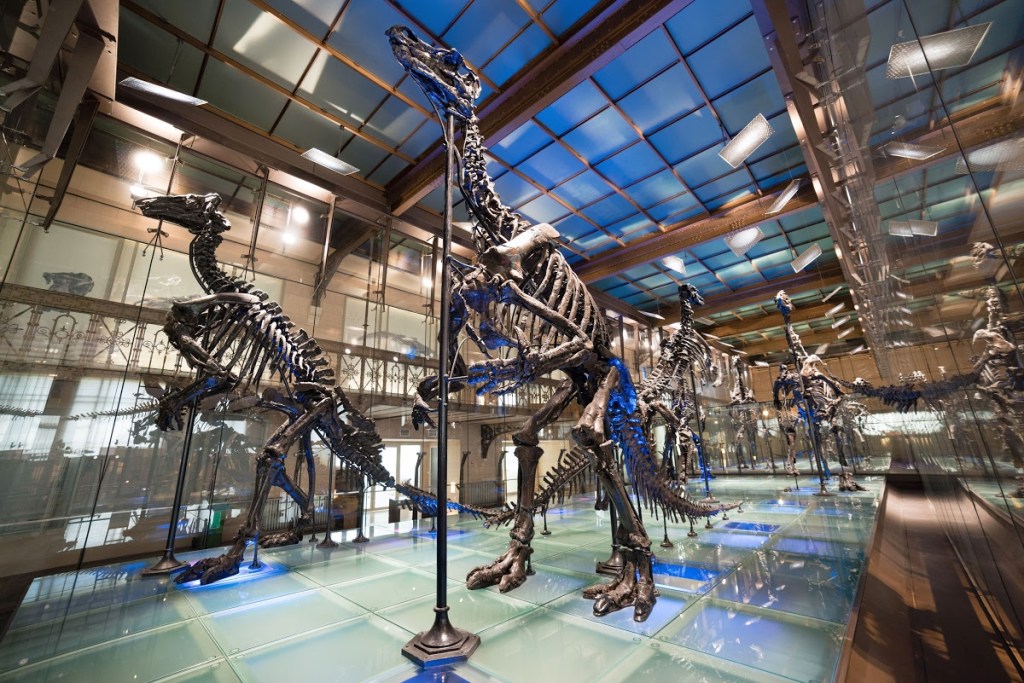
The Bernissart Iguanodon specimens on display at the Museum of Natural Sciences in Belgium. These Iguanodon specimens were discovered in a coal mine in Bernissart in Belgium in 1878. Image credit: Google Arts & Culture, 2023.

Iguanodon has had an interesting palaeontological history, going through various changes to its skeletal reconstruction and depiction since the 1800s. Originally Iguanodon was perceived as a slow, large lizard like creature with a spike on its nose, the placement of the spike which Gideon Mantell had wrongly assumed was a nose horn.

The lizard like perception of Iguanodon led into the development of the Iguanodon statues of The Crystal Palace Dinosaurs, which can still be seen in London today. These dinosaur statues remain a monument to the perception of dinosaurs at that time, and an important piece of the United Kingdom’s palaeontological history. You can check out the video below where Professor Mike Benton gives an overview of The Crystal Palace Dinosaurs and the palaeontology of the 1800s.

Professor Mike Benton provides an overview of the history of The Crystal Palace Dinosaurs in this video from Friends of Crystal Palace Dinosaurs.

What we know of Iguanodon today is quite different compared to how it was perceived during Gideon Mantell’s time. The dinosaur has seen a large amount of research covering its fossil occurrences, skeletal anatomy, and palaeobiology. The number of fossil occurrences, advances in palaeontological data analyses and research have enabled a deeper insight into Iguanodons palaeobiology.

Iguanodon displays a number of distinct features that make it an iconic dinosaur. The dinosaur is big and bulky with its long arms stretching below the animal, supporting its heavy weight.

The hands display a thumb spike along with three fused phalanges which were used by the dinosaur to support itself and walk on. The fifth digit is at an angle from the wrist and is likely to have been used for grasping vegetation by the dinosaur when feeding.

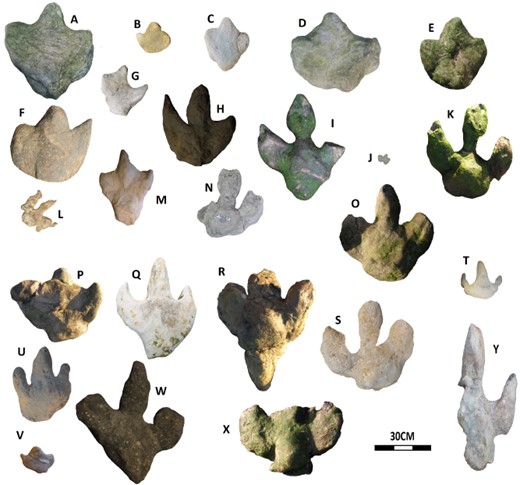
On the Isle of Wight many ornithopod dinosaur footprints have been analysed and attributed to Iguanodon, with Hanover Point being the focus of much dinosaur footprint research. The 2014 paper by Lockwood and co-authors surveyed the dinosaur foot casts and prints found at Hanover Point on the island.

A selection of dinosaur foot print casts from Hanover Point on the Isle of Wight with 30 cm scale bar. Image credit: Lockwood et al. 2014.

This research involved photographing the foot casts and measuring them, along with making field sketches to help document their morphology and distribution. Over one hundred and fifty dinosaur footprints were documented in the study, with one hundred and thirty-eight of these being identified as made from ornithopod dinosaurs.

The results of the study documented tridactyl tracks being preserved as casts, with some being made under water with identifiable ripple marks, denoting they were made within a fluvial environment. 3D data used through photogrammetry of a natural footprint cast displayed evidence of quadrupedal gait, due to identifiable pes and manus on the footprint with Iguanodon bernissartensis considered the likely match.

Photogrammetry image of ornithopod print showing natural casts of pes and manus (A). (B) displays sketch of the print
complex. (C) displays the false colour image of the manus, potentially showing the pollex (thumb) impression. Image credit: Lockwood et al. 2014.

Smaller ornithopod prints were less common at Hanover Point, and it was not entirely clear why this might be the case. Hypotheses for limited smaller ornithopod prints include preservation and erosion bias, or smaller dinosaurs being less common due to rapid growth rates. Some of the footprint casts analysed in the research were also consistent with theropod dinosaurs, displaying thinner digits.

Iguanodon remains an important dinosaur which has undergone a radical change in public perception due to the advances in scientific evidence and knowledge. New discoveries and palaeontological research on Iguanodon are furthering our understanding of its life history during the Early Cretaceous.

Along with The Crystal Palace Dinosaurs statues, Iguanodon has featured in many books, documentaries, films, and magazines. Major appearances of the dinosaur include Sir Arthur Conan Doyle’s acclaimed novel The Lost World (1912), the documentary series Walking with Dinosaurs (1999) and the Disney film Dinosaur (2000).

I hope this profile and additional info on Iguanodon bernissartensis has been engaging. This is the fifth dinosaur profile I have worked on, and more will be on the way soon. If you have not already done so do check out the other dinosaur profiles if you have enjoyed this one!

I have been working hard to improve the science communication of the website, with a number of pages being added to increase its outreach capacity. The science communication tab and dinosaur profile tab have been immensely popular with new readers.

Enjoyed this post? Support my science outreach.

cards
Powered by paypal

References

Iguanodon bernissartensis skeletal by Dr. Scott Hartman skeletaldrawing.com.

Dinosaur silhouettes from Phylopic.org by Dr. Scott Hartman and used under the Attribution 3.0 Unported license.

1. Lockwood, J., Lockley, M., & Pond, S. (2014) A review of footprints from the Wessex Formation (Wealden Group, Lower Cretaceous) at Hanover Point, Isle of Wight, Southern England. Biological Journal of the Linnean Society. 113, (3) p. 707

Iguanodon hand image Natural History Museum (2023) NHM Website. https://www.nhm.ac.uk/discover/the-discovery-of-iguanodon.html 

Zalmoxes robustus

The above profile for Zalmoxes robustus covers its temporal range, fossil location, ontogeny, and jaw morphology, with additional palaeontological information and references provided below.

Zalmoxes robustus was a small ornithopod dinosaur that was part of the Rhabdodontidae family (iguanodontian ornithopods). Zalmoxes lived during the Late Cretaceous in what is now known as Romania. This dinosaur was an active bipedal herbivore which lived off low lying vegetation such as horsetails, angiosperms, and ferns.

Zalmoxes robutus fossilised remains have been found within the Sânpetru Formation, Sebes Formation and Densuș-Ciula Formation of Romania. Remains have been found mostly within the Hateg Basin, which was once a large offshore island during the Late Cretaceous. There are two species of Zalmoxes, Zalmoxes robustus which is the focus of the fact file above and Zalmoxes shqiperorum which is also found in Romania.

A juvenile Zalmoxes as depicted in Episode 5 Forests in Prehistoric Planet S1. Image credit: Apple TV +, 2023.

Zalmoxes was renamed officially in 2003 having been named as a species of Mochlodon by Baron Franz Nopcsa in 1899 who discovered the type specimen (BMNH R3392). Nopcsa put forward the theory that insular dwarfism occurred on Hateg Island due to limited resources which led to smaller dinosaur species over generations. Zalmoxes was therefore thought of as an island dwarf, alongside other dinosaurs of the island such as the titanosaur Magyarosaurus.

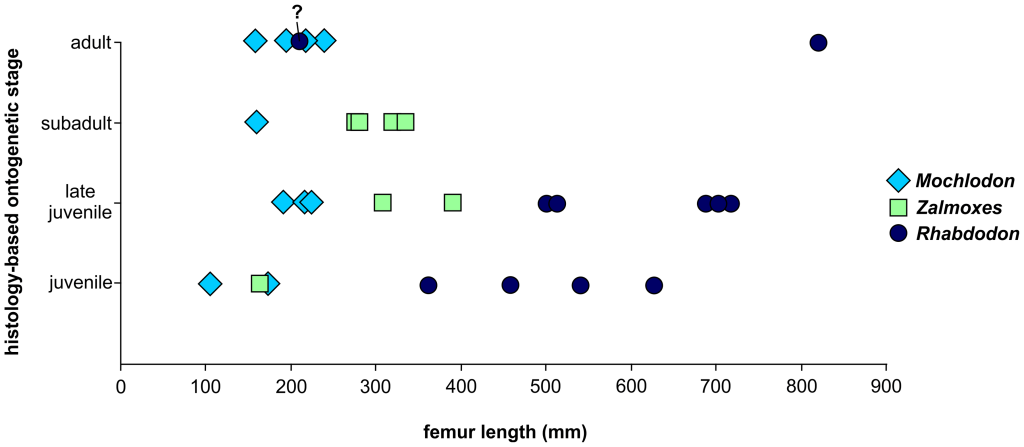
Zalmoxes has seen a fair amount of palaeontological research covering its phylogenetic placement and bone histology. The 2012 research paper by Ősi and co-authors examined body size evolution within rhabdodontid ornithopods including Zalmoxes. The research incorporated bone histology sampling to assess ontogenetic stages along with phylogenetic analyses assessing phylogenetic positions.

Plot of femoral length vs histological ontogenetic stage of the histologically sampled specimens covering Mochlodon, Zalmoxes and Rhabdodon. The outlier with a question mark fits the femoral length of an adult Mochlodon species.
Image credit: Ősi et al. 2012.

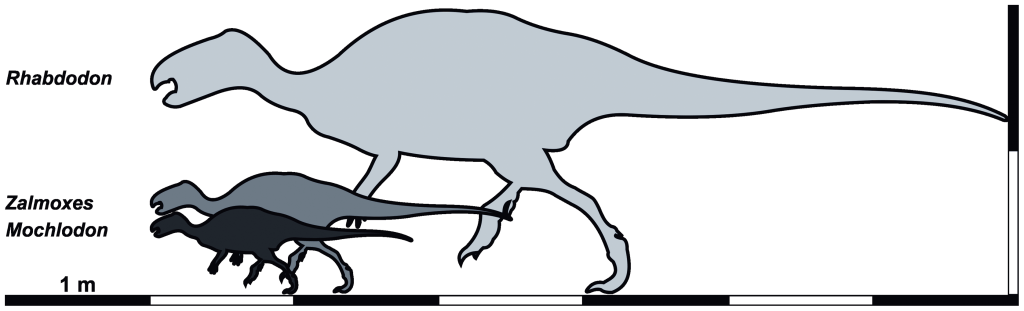
The research found that the hypotheses for nanism (dwarfism) for the Mochlodon-Zalmoxes clade was not well supported, suggesting the island-dwarf hypothesis of Hateg Island should be re-examined. The results showed a broad divergence between western rhabdodontids before the Santonian, which are composed of two species of Rhabdodon in France and Spain and an eastern lineage composed of Zalmoxes and Mochlodon.

Size comparison of rhabdodontids histology body sizes of Rhabdodon, Zalmoxes and Mochlodon. Dinosaurs are represented by silhouettes. Image credit: Ősi et al. 2012.

Such research into body size evolution of rhabdodontids is enabling a deeper insight into Zalmoxes palaeobiology, alongside a re-examination of previously thought ideas surrounding island dwarfism.

Whilst Zalmoxes may be a lesser-known dinosaur to most of the general public outside of Romania, it has made appearances on screen. Appearing in the documentary series Dinosaur Planet (2003) and both seasons of the critically acclaimed Apple TV + documentary series Prehistoric Planet (2022-present).

Enjoyed this post? Support my science outreach.

cards
Powered by paypal

References

Zalmoxes robustus  skeletal by Dr. Scott Hartman skeletaldrawing.com.

Dinosaur silhouettes from Phylopic.org by Dr. Scott Hartman and used under the Attribution 3.0 Unported license.

1. Ősi, A., Prondvai, E., Butler, R. & Weishampel D. B., (2012) Phylogeny, Histology and Inferred Body Size Evolution in a New Rhabdodontid Dinosaur from the Late Cretaceous of Hungary. PLOS ONE. 7 (9). p. 3

2. Weishampel, D. B., Jianu, C. M., Csiki, Z. & Norman, D. B. (2003) Osteology and phylogeny of Zalmoxes (n. g.), an unusual Euornithopod dinosaur from the latest Cretaceous of Romania. Journal of Systematic Palaeontology. 1 (2) p. 110