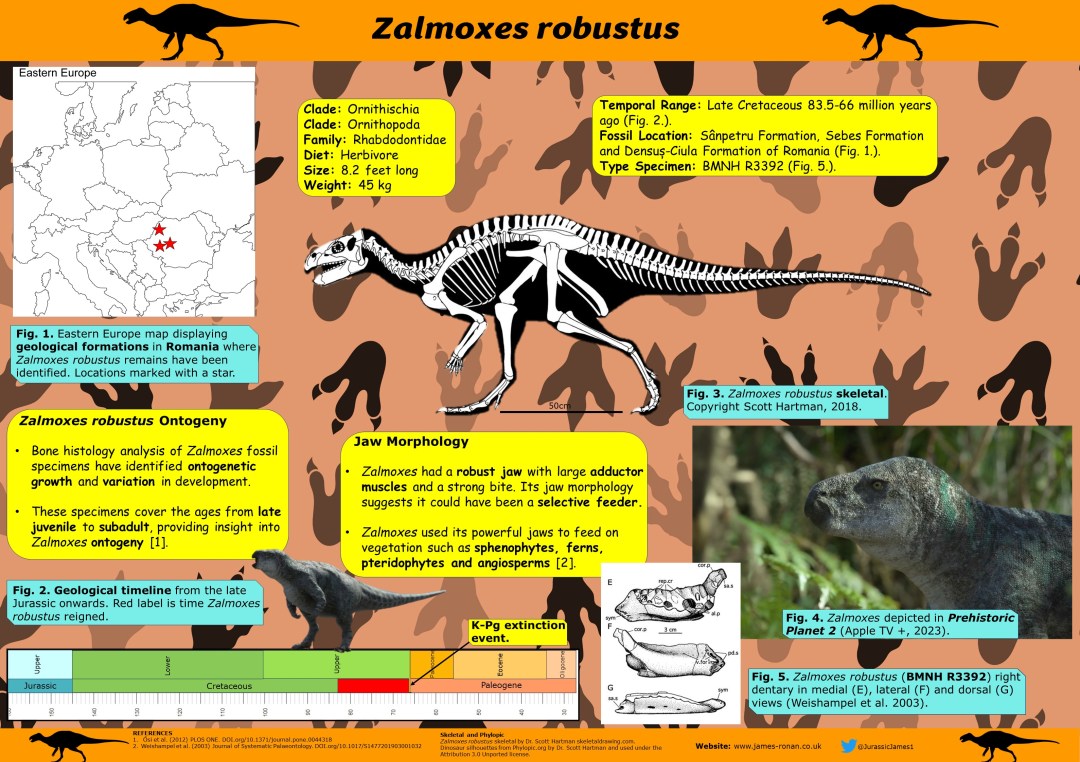
The above profile for Zalmoxes robustus covers its temporal range, fossil location, ontogeny, and jaw morphology, with additional palaeontological information and references provided below.
Zalmoxes robustus was a small ornithopod dinosaur that was part of the Rhabdodontidae family (iguanodontian ornithopods). Zalmoxes lived during the Late Cretaceous in what is now known as Romania. This dinosaur was an active bipedal herbivore which lived off low lying vegetation such as horsetails, angiosperms, and ferns.
Zalmoxes robutus fossilised remains have been found within the Sânpetru Formation, Sebes Formation and Densuș-Ciula Formation of Romania. Remains have been found mostly within the Hateg Basin, which was once a large offshore island during the Late Cretaceous. There are two species of Zalmoxes, Zalmoxes robustus which is the focus of the fact file above and Zalmoxes shqiperorum which is also found in Romania.

Zalmoxes was renamed officially in 2003 having been named as a species of Mochlodon by Baron Franz Nopcsa in 1899 who discovered the type specimen (BMNH R3392). Nopcsa put forward the theory that insular dwarfism occurred on Hateg Island due to limited resources which led to smaller dinosaur species over generations. Zalmoxes was therefore thought of as an island dwarf, alongside other dinosaurs of the island such as the titanosaur Magyarosaurus.
Zalmoxes has seen a fair amount of palaeontological research covering its phylogenetic placement and bone histology. The 2012 research paper by Ősi and co-authors examined body size evolution within rhabdodontid ornithopods including Zalmoxes. The research incorporated bone histology sampling to assess ontogenetic stages along with phylogenetic analyses assessing phylogenetic positions.
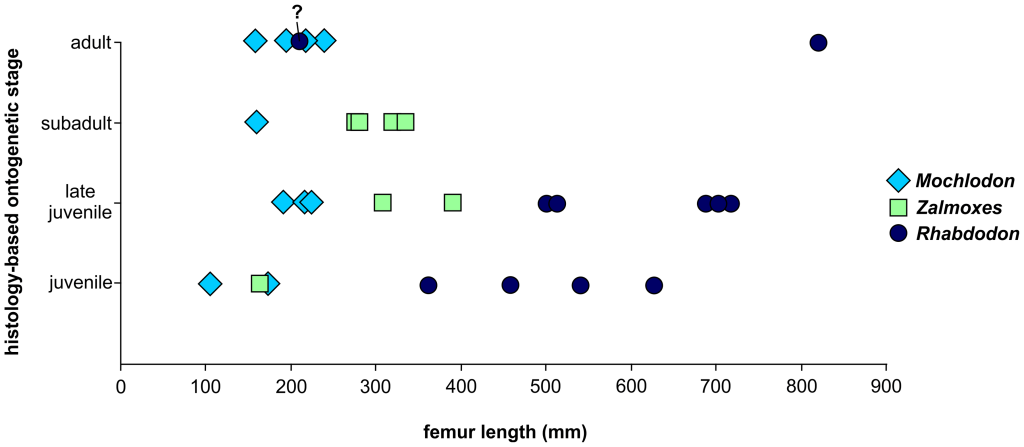
Image credit: Ősi et al. 2012.
The research found that the hypotheses for nanism (dwarfism) for the Mochlodon-Zalmoxes clade was not well supported, suggesting the island-dwarf hypothesis of Hateg Island should be re-examined. The results showed a broad divergence between western rhabdodontids before the Santonian, which are composed of two species of Rhabdodon in France and Spain and an eastern lineage composed of Zalmoxes and Mochlodon.
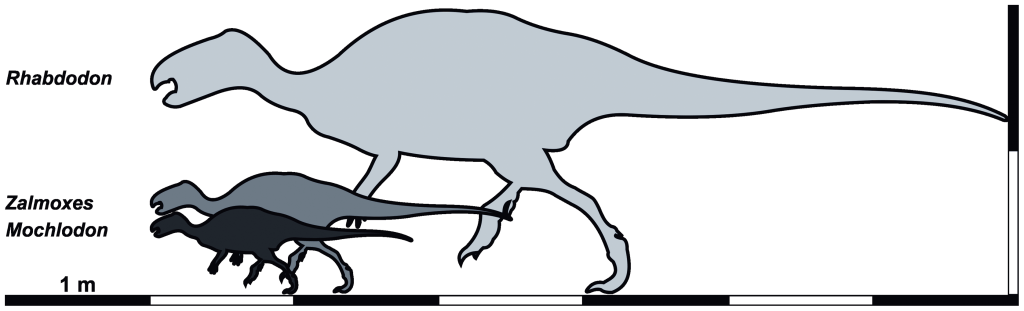
Such research into body size evolution of rhabdodontids is enabling a deeper insight into Zalmoxes palaeobiology, alongside a re-examination of previously thought ideas surrounding island dwarfism.
Whilst Zalmoxes may be a lesser-known dinosaur to most of the general public outside of Romania, it has made appearances on screen. Appearing in the documentary series Dinosaur Planet (2003) and both seasons of the critically acclaimed Apple TV + documentary series Prehistoric Planet (2022-present).
Enjoyed this post? Support my science outreach.
References
Zalmoxes robustus skeletal by Dr. Scott Hartman skeletaldrawing.com.
Dinosaur silhouettes from Phylopic.org by Dr. Scott Hartman and used under the Attribution 3.0 Unported license.
