
The above profile for Iguanodon bernissartensis covers its temporal range, fossil location, fossilised footprints, and thumb spike, with further details on its palaeontological history and references below.
Iguanodon bernisssartensis was a large iguanodontian dinosaur that lived throughout the Early Cretaceous. Iguanodon was a quadruped capable of moving on all fours. This dinosaur was capable of reaching sizes in excess of thirty feet and weighed up to five tonnes.
Iguanodon had an advanced jaw system using its beak to crop vegetation. It used its exceptional teeth to grind up vegetation into a palp to be swallowed. Iguanodon is considered to have been a low browser, feeding on Cretaceous angiosperms although it was able to reach vegetation at height. Iguanodons teeth were replaceable, and this enabled the dinosaur to continuously feed for the rest of its life, breaking down tough plant matter.

Palaeontologist and geologist Gideon Mantell named Iguanodon in 1825 and the dinosaur was one of the first dinosaurs to be described. Along with Megalosaurus and Hylaeosaurus, Iguanodon was one of three genera that British palaeontologist Sir Richard Owen based the clade Dinosauria on.
Fossilised remains of Iguanodon have been identified throughout Europe in the Wessex Formation of the United Kingdom, Sainte-Barbe Clays Formation in Belgium, Argile Ostréenne and Grès et Sables Piquetés Formation in France, and the Bückeberg Formation in Germany. In Spain Iguanodon remains have been identified in the Camarillas, Arcillas de Morella, Capas Rojas, and El Collado Formations.
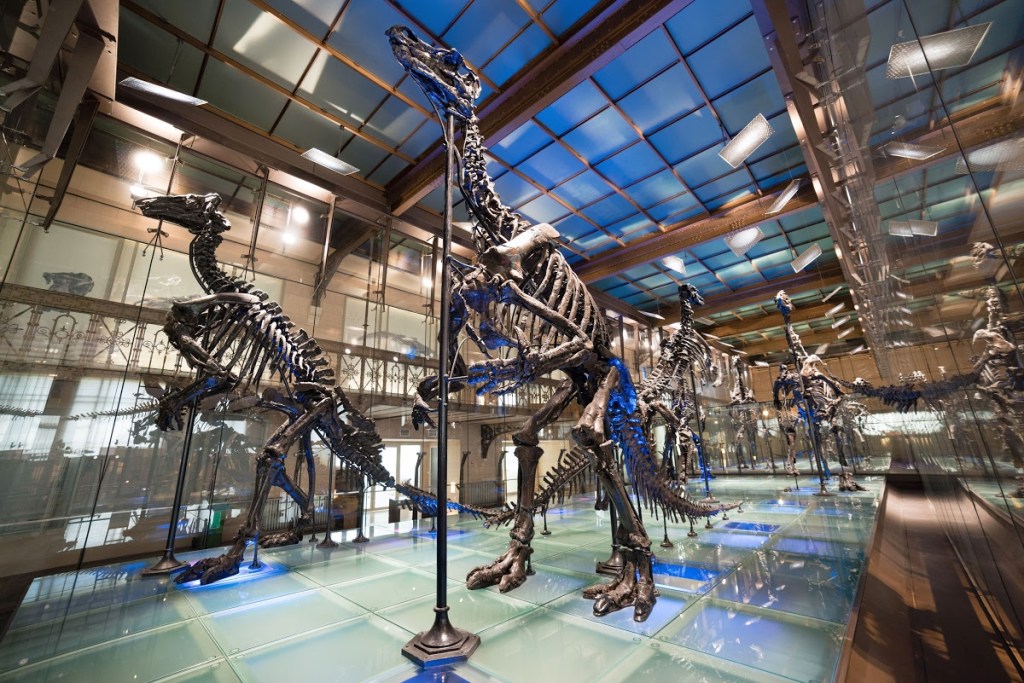
Iguanodon has had an interesting palaeontological history, going through various changes to its skeletal reconstruction and depiction since the 1800s. Originally Iguanodon was perceived as a slow, large lizard like creature with a spike on its nose, the placement of the spike which Gideon Mantell had wrongly assumed was a nose horn.
The lizard like perception of Iguanodon led into the development of the Iguanodon statues of The Crystal Palace Dinosaurs, which can still be seen in London today. These dinosaur statues remain a monument to the perception of dinosaurs at that time, and an important piece of the United Kingdom’s palaeontological history. You can check out the video below where Professor Mike Benton gives an overview of The Crystal Palace Dinosaurs and the palaeontology of the 1800s.
What we know of Iguanodon today is quite different compared to how it was perceived during Gideon Mantell’s time. The dinosaur has seen a large amount of research covering its fossil occurrences, skeletal anatomy, and palaeobiology. The number of fossil occurrences, advances in palaeontological data analyses and research have enabled a deeper insight into Iguanodons palaeobiology.
Iguanodon displays a number of distinct features that make it an iconic dinosaur. The dinosaur is big and bulky with its long arms stretching below the animal, supporting its heavy weight.
The hands display a thumb spike along with three fused phalanges which were used by the dinosaur to support itself and walk on. The fifth digit is at an angle from the wrist and is likely to have been used for grasping vegetation by the dinosaur when feeding.
On the Isle of Wight many ornithopod dinosaur footprints have been analysed and attributed to Iguanodon, with Hanover Point being the focus of much dinosaur footprint research. The 2014 paper by Lockwood and co-authors surveyed the dinosaur foot casts and prints found at Hanover Point on the island.
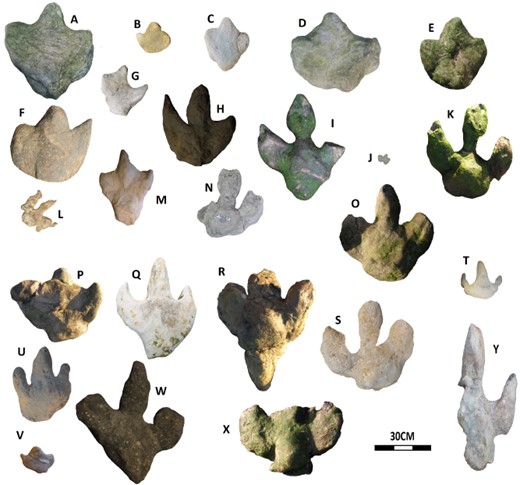
This research involved photographing the foot casts and measuring them, along with making field sketches to help document their morphology and distribution. Over one hundred and fifty dinosaur footprints were documented in the study, with one hundred and thirty-eight of these being identified as made from ornithopod dinosaurs.
The results of the study documented tridactyl tracks being preserved as casts, with some being made under water with identifiable ripple marks, denoting they were made within a fluvial environment. 3D data used through photogrammetry of a natural footprint cast displayed evidence of quadrupedal gait, due to identifiable pes and manus on the footprint with Iguanodon bernissartensis considered the likely match.

complex. (C) displays the false colour image of the manus, potentially showing the pollex (thumb) impression. Image credit: Lockwood et al. 2014.
Smaller ornithopod prints were less common at Hanover Point, and it was not entirely clear why this might be the case. Hypotheses for limited smaller ornithopod prints include preservation and erosion bias, or smaller dinosaurs being less common due to rapid growth rates. Some of the footprint casts analysed in the research were also consistent with theropod dinosaurs, displaying thinner digits.
Iguanodon remains an important dinosaur which has undergone a radical change in public perception due to the advances in scientific evidence and knowledge. New discoveries and palaeontological research on Iguanodon are furthering our understanding of its life history during the Early Cretaceous.
Along with The Crystal Palace Dinosaurs statues, Iguanodon has featured in many books, documentaries, films, and magazines. Major appearances of the dinosaur include Sir Arthur Conan Doyle’s acclaimed novel The Lost World (1912), the documentary series Walking with Dinosaurs (1999) and the Disney film Dinosaur (2000).
I hope this profile and additional info on Iguanodon bernissartensis has been engaging. This is the fifth dinosaur profile I have worked on, and more will be on the way soon. If you have not already done so do check out the other dinosaur profiles if you have enjoyed this one!
I have been working hard to improve the science communication of the website, with a number of pages being added to increase its outreach capacity. The science communication tab and dinosaur profile tab have been immensely popular with new readers.
Enjoyed this post? Support my science outreach.
References
Iguanodon bernissartensis skeletal by Dr. Scott Hartman skeletaldrawing.com.
Dinosaur silhouettes from Phylopic.org by Dr. Scott Hartman and used under the Attribution 3.0 Unported license.
Iguanodon hand image Natural History Museum (2023) NHM Website. https://www.nhm.ac.uk/discover/the-discovery-of-iguanodon.html
