
The above profile for Hypacrosaurus stebingeri covers its temporal range, fossil location, embryonic development, and cranial research, with additional palaeontological information and references provided below.
Hypacrosaurus stebingeri was a large lambeosaurine hadrosaurid that lived throughout the Late Cretaceous 83.5 to 72.1 million years ago. Hypacrosaurus stebingeri like other lambeosaurine dinosaurs was a herbivore and capable of moving bipedally or quadrupedally.
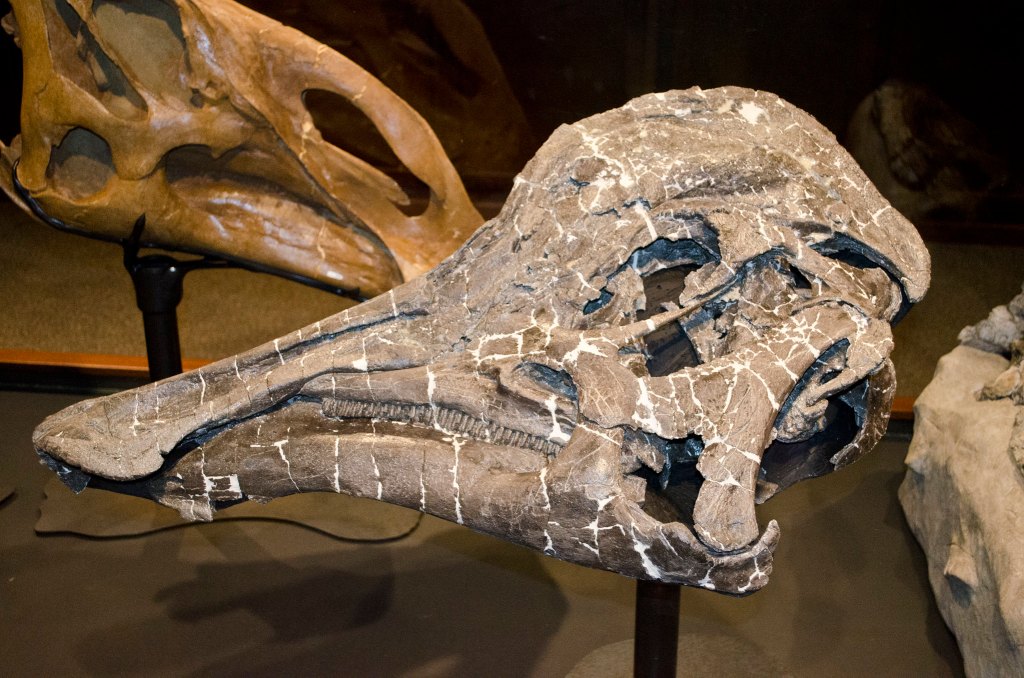
Many nesting sites and juvenile egg clutches of Hypacrosaurus have been identified suggesting this dinosaur lived in herds and that it provided parental care for extended periods of time. Hypacrosaurus stebingeri remains have been identified in the Oldman Formation of Alberta Canada and the Two Medicine Formation of Montana USA.
Two species of Hypacrosaurus are known, Hypacrosaurus stebingeri which is the focus of this fact file and Hypacrosaurus altispinus. Hypacrosaurus altispinus was the first specimen discovered in 1910 by palaeontologist Barnum Brown in Alberta Canada, who identified the holotype (AMNH 5204). The holotype specimen of Hypacrosaurus stebingeri (MOR 549) pictured above was discovered in 1994, from Badger Creek in the Two Medicine Formation.
Hypacrosaurus has seen extensive palaeontological research since the 1990s covering its anatomy, jaw adductor mechanics, cellular preservation, and size-frequency distribution providing analysis of Hypacrosaurus palaeobiology and life history. The 2016 research paper by Erickson and co-authors examined nonavian dinosaur incubation periods, examining Von Ebner incremental lines in embryonic Hypacrosaurus teeth.
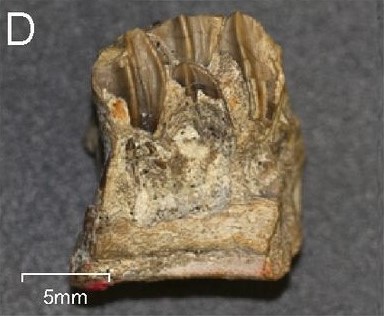
The fossil Hypacrosaurus embryos used in the study were recovered from nests in the fluvial out bank deposits within the Oldman Formation of Alberta. The Hypacrosaurus eggs had dimensions of 18.5 x 20cm with an estimated volume of 3,900 cc. The study identified daily forming growth lines within the embryonic teeth with slower embryonic development across months, more akin to embryonic development seen in extant (present day) reptilian embryos.

As a result of the longer embryonic development times there were increased risks identified such as predation, starvation, and environmental factors which would have impacted the hadrosaurid eggs and parents. This research has enabled a deeper insight into Hypacrosaurus development and risks associated with increased incubation times throughout the Late Cretaceous.
I hope this profile and additional info on Hypacrosaurus stebingeri has been insightful and worth reading. New palaeontological research is providing a greater understanding of lambeosaurine hadrosaurids, you can learn more about other lambeosaurines like Lambeosaurus lambei here.
Enjoyed this post? Support my science outreach.
References
Hypacrosaurus stebingeri skeletal by Dr. Scott Hartman skeletaldrawing.com.
Dinosaur silhouettes from Phylopic.org by Dmitry Bogdanov and used under the Attribution 3.0 Unported license.
