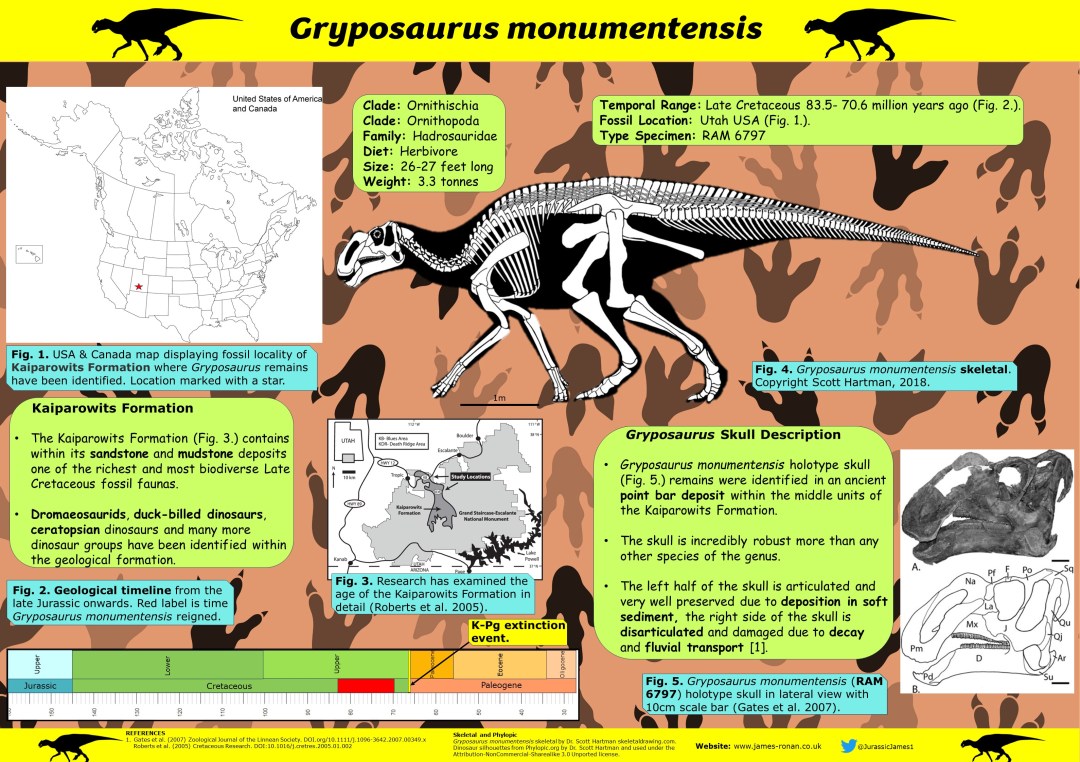
The above profile for Gryposaurus monumentensis outlines its temporal range, fossil location, skull description, and details of the Kaiparowits Formation, where it was discovered. Additional palaeontological research and references are provided below.

Gryposaurus monumentensis was a saurolophine hadrosaurid which lived throughout the Late Cretaceous from 83.5 to 70.6 million years ago. Gryposaurus was a social dinosaur and was capable of moving both bipedally and quadrupedally.
This dinosaur like other hadrosaurids was a herbivore and its dental battery was packed full of hundreds of teeth, perfect for slicing through tough plant matter. Gryposausus had replacement teeth, waiting to be used and these sustained the dinosaur’s browsing on fibrous plant vegetation over its lifetime.
Gryposaurus monumentensis has seen a fair amount of palaeontological research since its announcement in 2007. Research has covered its palaeobiology, cranial development, and phylogeny. The 2007 research paper by Gates and Sampson examined the anatomy of Gryposaurus monumentensis through comparison with other Gryposaurus species.
Gryposaurus monumentensis was identified to have distinguished features such as more robust skull and jaws, including a smaller infratemporal fenestra. Other unique morphologies included the large prongs on the margin of the predentary and a median flange on the surangular.

The research observed the biostratigraphy of where the Gryposaurus remains had been found with Gryposaurus monumentensis only known from the middle unit of the Kaiparowits Formation.
A faunal turnover of the species in the southern part of the Western Interior Basin during the Late Cretaceous was suggested as four Gryposaurus species have been identified across the USA and Canada. These species cover over five million years of geological time from 80 to 74.5 million years ago with extensive geographic range (over 2,000 km), one of the largest within dinosaur genera.
There has been much research into the stratigraphy and palaeo fauna of the Kaiparowits Formation where Gryposaurus remains have been located. The dinosaur shared its environment with a number of dinosaur taxa such as the tyrannosaurid Teratophoneus curriei, ceratopsians like Nasutoceratops titusi and Kosmoceratops richardsoni and other duck-billed dinosaurs like Parasaurolophus cyrtocristatus. There were a host of other non-avian dinosaurs that occupied the Kaiparowits Formation during this time as well.
The palaeoenvironment during the Late Cretaceous was incredibly rich and biodiverse supporting a wide range of species. Fossilised remains for a wealth of other wildlife have also been recognised within the geological formation from chondrichthyans (cartilaginous fishes such as sharks and rays) to amphibians, turtles, and crocodilians. Palaeoenvironment studies have enabled further insight into the life of Gryposaurus monumentensis and the palaeo fauna it lived alongside.
I hope this profile and article on Gryposaurus monumentensis has been insightful and provided a good breakdown of its palaeobiology and life history. There is a lot of palaeontological information which has been retrieved from Gryposaurus since its discovery in 2007 and continued research should provide more insight into the species development of saurolophine hadrosaurids.
Enjoyed this post? Support my science outreach.
References
Gryposaurus monumentensis skeletal by Dr. Scott Hartman skeletaldrawing.com.
Dinosaur silhouettes from Phylopic.org by Dr. Scott Hartman and used under the Attribution-NonCommercial-Sharealike 3.0 Unported license.
