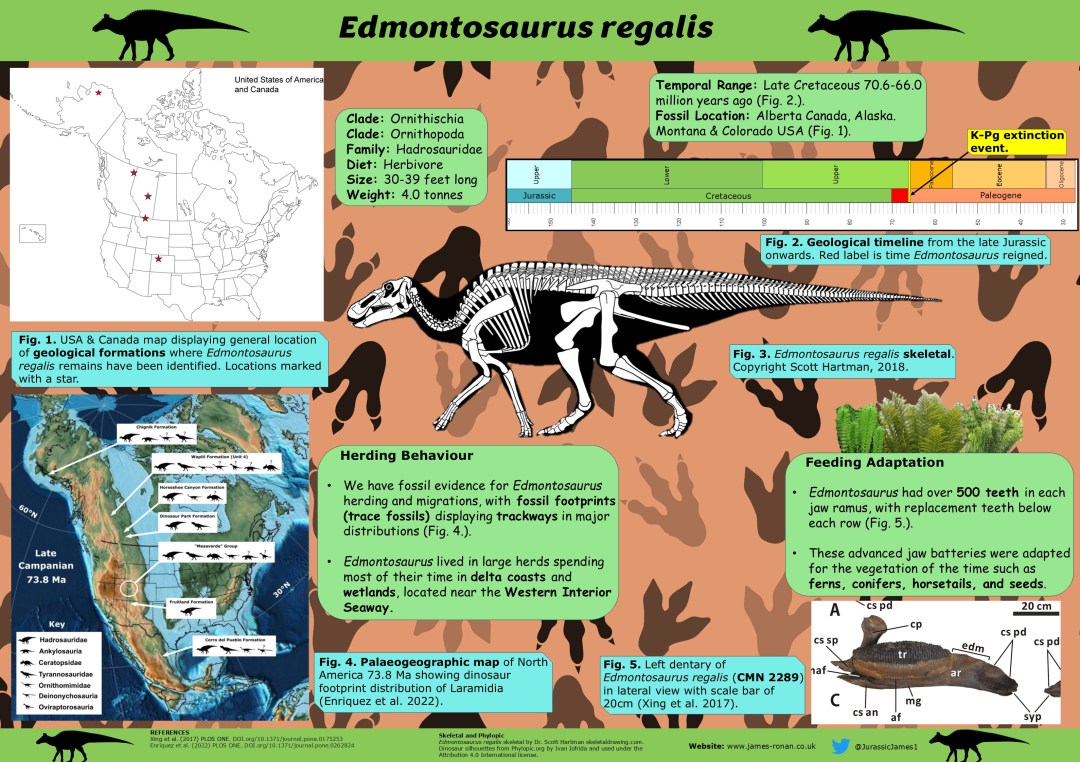
The above profile for Edmontosaurus regalis covers its geological distribution, feeding adaptation, and herding behaviour, with additional palaeontological information and references provided below
Edmontosaurus regalis was a large duck-billed dinosaur, part of the saurolophine family of hadrosaurids. The dinosaur lived throughout the Late Cretaceous 70.6 to 66.0 million years ago, and the type specimen of Edmontosaurus regalis (NMC 2288) was named by Lawrence Lamb in 1917.
Its fossilised remains have been found at the following geological formations; the Horseshoe Canyon Formation and Wapiti Formation in Alberta Canada, Prince Creek Formation in Alaska, St. Mary River Formation (Alberta and Montana) and in the Laramie Formation in Colorado, USA.
Edmontosaurus regalis was an active dinosaur able to move both bipedally and quadrupedally, capable of travelling great distances. Due to extensive hadrosaurid bonebed occurrences and evidence of nesting sites, hadrosaurs like Edmontosaurus are considered to have been highly social dinosaurs and were very parental, looking after their young for an extended period of time.
Edmontosaurus like most hadrosaurs had advanced dental batteries which were used to grind up tough vegetation into a palp to be swallowed. These dental batteries were packed with teeth in each jaw battery and would be continuously replaced during the dinosaur’s lifetime, although only some would be used at only one time.
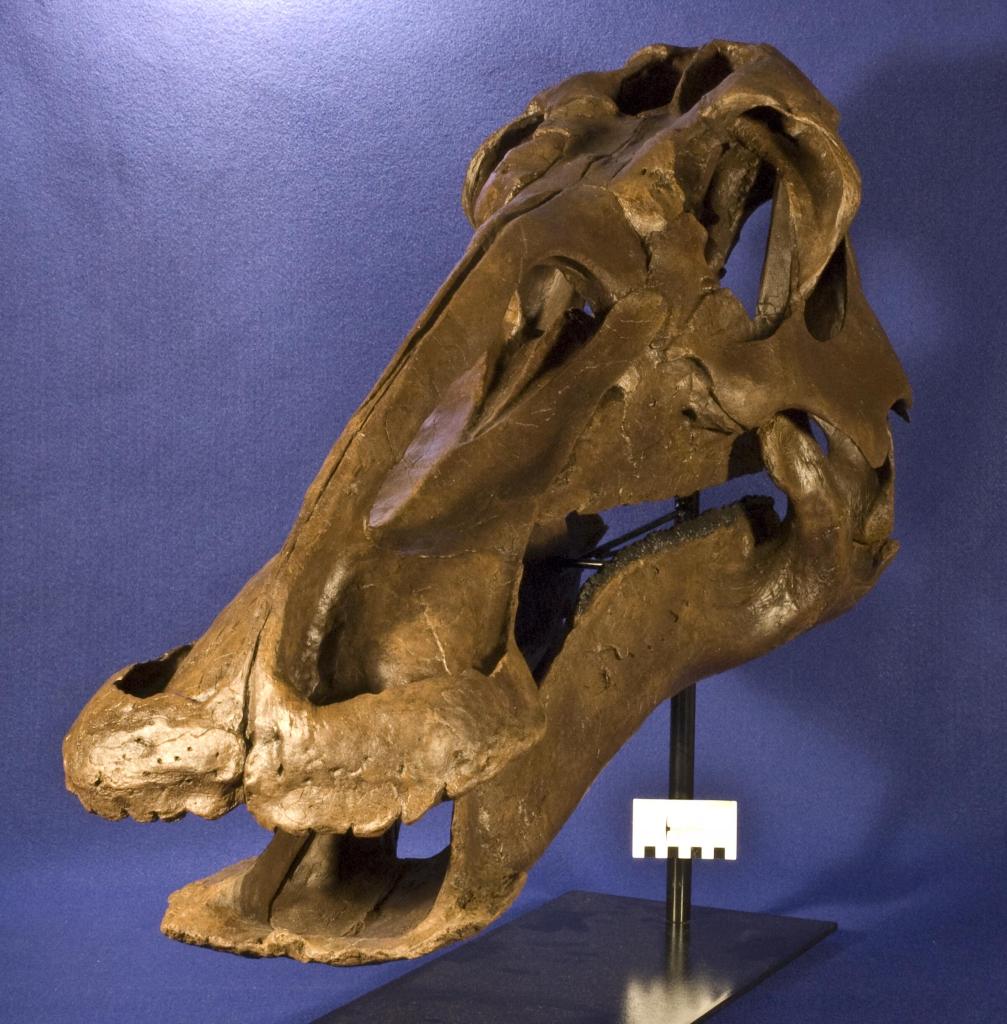
In 2014 it was discovered that Edmontosaurus regalis displayed a fleshy comb on its head relating to potential social or sexual selection signalling behaviour. The evidence from a mummified specimen of Edmontosaurus regalis (UALVP 53722) suggested Edmontosaurus was a highly visual dinosaur.
Saurolophine hadrosaurs like Edmontosaurus lacked the hollow cranial ornamentation of the crested Lambeosaurine hadrosaurs. This research identified a first for soft tissue signalling structures within a dinosaur, which is part of the Saurolophinae clade and evidence for Edmontosaurus social behaviour.
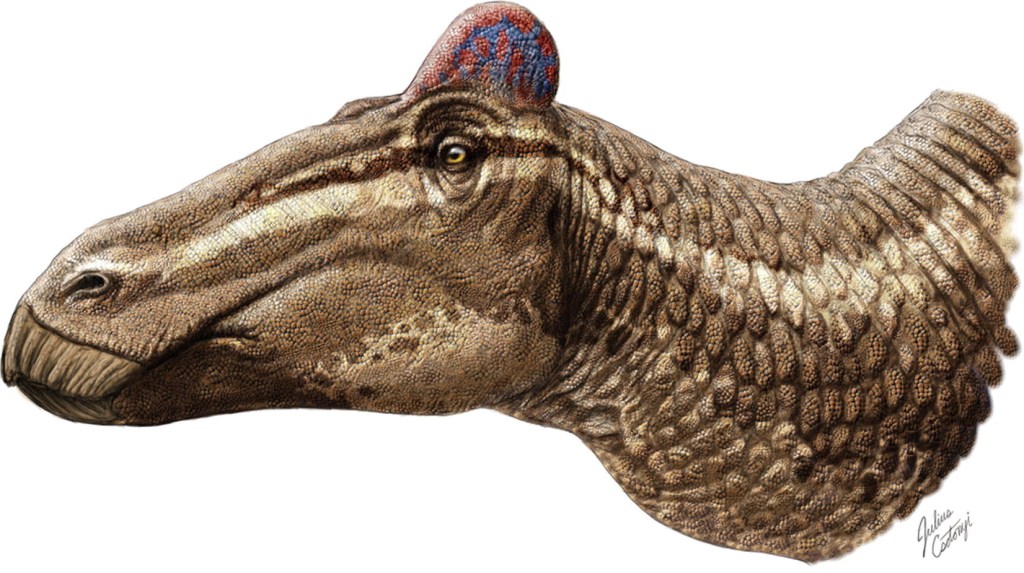
Edmontosaurus has seen an incredible amount of palaeobiology research over the years focusing on its skull growth, evolutionary rates, dental structure, jaw biomechanics, and migratory patterns. New research, fossil discoveries and palaeoenvironmental analyses are enabling an in-depth investigation into this dinosaur’s palaeobiology and the environment it lived in.
Enjoyed this post? Support my science outreach.
References
Edmontosaurus regalis skeletal by Dr. Scott Hartman skeletaldrawing.com.
Edmontosaurus regalis silhouettes from Phylopic.org by Ivan Iofrida and used under the Attribution 4.0 International license.
