In this article I cover my academic experience of getting into palaeontology and share my story of how I got to where I am.
Ok, before I get into this article, I want you all to know that I am coming at this purely from the academic/volunteering side of things. I want to help those who feel they do not have what it takes to study palaeontology due to their current life circumstances or qualifications. Please do not let this stop you!
First, I want to say that I passed my MSc in Palaeobiology July 2022, something of which I still find surreal to say. You will probably be surprised to learn though that the journey to my MSc has not been simple or easy at all.
For those of you who have an interest in palaeontology, are considering building up the necessary experience to get into it or are just interested in my journey, I hope this article will be helpful for you. I have had a few people ask me to write this type of article, so I figured now was the best time to share.
My Academic Journey
I would not consider myself academically gifted. I am dyspraxic and I also have dyscalculia which means I really struggle with Maths. As a young child all I wanted to be when I was older was a palaeontologist, it was the only career I wanted. I loved dinosaurs and I wanted to spend my time digging dinosaur bones up and researching them.
It was during my teen years that I was unfortunately put off the idea of palaeontology by my college’s careers advisor (mad I know, but I have heard many stories of poor advice similar to mine). “Based on your grades this career isn’t possible. You would also need to get a master’s and a PHD to even get into that career” she said.
I believe I was about 15 during this time (difficult to remember my age) but that advice sure did put a dampener on my hopes, it pulled the rug out from underneath my feet! My interest quickly swayed from palaeontology to Geography, where I found an interest in a topic that was more about people and places, alongside Earth Science. I figured maybe I could develop a career in the humanitarian sector instead (that seemed more achievable).
My grades across my GCSES were not great at all but I did get 5 passes (respectable Cs and 2 B’s, although I failed Maths and Science!). Thankfully, I was allowed onto my A-Levels, where I took Geography, History and Philosophy and Ethics as my 3 choices going forward. However, just getting to my A-Levels required a resit of my English GCSE and re-taking the lessons, as well as undertaking a BTEC Business Diploma for about a year (which I got 6 A*s in).
My A-Levels were not a cakewalk either. I ended up failing the last Geography exam which brought my final grade down, but I passed the others. History was a struggle, as I found it difficult adapting to the exam structure in one of the papers.
I was getting U (U for Ungraded) in my class practice exam essays but after working to improve, I came out with a C in the final exam. It was during my A-Levels that my college went into special measures, so as you can imagine, the support I got throughout my time at college was incredibly poor and could have been miles better.
Studying Geography at Degree Level
But still, I persevered and applied to do a Geography degree at Plymouth University (which crazily was my only choice of uni at the time). I eventually passed the degree with a 2:2 (which included a year out, due to personal reasons). Again, my exam results on the Geography degree were not great, they were quite low compared to my coursework results.
Thankfully I had dyspraxia support from the uni and this helped with my time management and preparing myself better for my deadlines. I knew I preferred coursework over the intensity of exams and the disparity in my results was quite clear. In the end I passed the course after a lot of hard work. By 2016 I was about 3 years behind everyone else due to setbacks, not even considering my disabilities that held me back academically.
It was after finishing my degree during 2016 that I was accepted onto Step into the GAP, a gap year programme run by CAFOD a charity I had been involved in for many years. This gap year required me to move up to Blackpool from Devon to work in a Catholic college for a year, with the chance to go to Cambodia for a few weeks in 2017 to see the charities work. It was a fantastic experience; one I will ever be Thankful for.
After finishing the gap year and moving down to Wiltshire, it was then I decided to switch career paths (from charity work to palaeontology), again another big step. The idea of pursuing palaeontology again came about from just browsing on my laptop and thinking what do I really want to do deep down? What would make me happy? It led me down a really positive palaeo rabbit hole!
Pursuing Palaeontology
I looked to see what degree/master programmes I needed to do. I came across the MSc in Palaeobiology at Bristol first. It caught my eye immediately, due to its proximity to me but I also checked out some other palaeontology degree/master programmes in London and elsewhere in the UK. I decided to take the online Dino 101 MOOC modules from the University of Alberta in palaeontology as these were quickly accessible.
These were just short online courses, but gave me a good introduction to palaeontology and looked good on my CV. I also reached out to Professor Phil Currie in Alberta who ran the Dino 101 MOOC course and a few others for advice on what I needed to do to get into palaeontology, the advice I received was very helpful indeed and led me to applying to Bristol Uni to do the MSc in Palaeobiology.
After applying for the master’s at Bristol and getting knocked back initially due to not having much evidence of academic study or volunteering, I decided to get involved in volunteering at Bristol Museum and eventually made the move from Wiltshire to Bristol to try and get more involved.
As I was so keen to get onto the MSc I contacted University staff who suggested I try and get onto the At The Feet of the Dinosaurs internship Programme at Bristol, a summer internship project that would get me working on microvertebrate fossils and writing a proper scientific publication. This project I was told, might help me in building up the necessary experience needed to get on to the MSc at Bristol.

After a few emails back and forth with the University about the internship opportunity, it culminated with a meeting with Professor Mike Benton who ran the internship, and this led to me being accepted onto the programme, a project I worked on for 2 years. I will always be Thankful to Mike for giving me that opportunity. The microvertebrate project was incredibly fun, but difficult and it took a long time to bring the final journal article together.
All the volunteering at Bristol Museum, a week on the Isle of Wight volunteering with Dinosaur Isle Museum and learning I had done during this time helped me to create a great application that I would send into Bristol for a 2nd time, eventually leading me to be accepted onto the master’s programme (Manchester Uni and Edinburgh Uni were also options I could pursue if I did not get in).
Studying Palaeontology at Masters Level
As you can imagine I was absolutely thrilled when I got onto the Palaeobiology MSc at Bristol. It is the best research group in the world for palaeontology. I was going to have the opportunity to study palaeontology at master’s level! Something of which I was told I would never achieve because my GCSE grades were bad. “It just would not be achievable” Well anything is achievable when you work hard enough!
However, just like my previous studies this was no easy task. Unfortunately for me, I ended up failing all four of my course exams, despite studying hard for them. I was also finishing off my journal article project (which helped get me on the MSc in the first place) alongside my Masters studies, which impacted my ability to give my all during this time. It was a massive knock to me. It led to me being in a very difficult, precarious situation. I had to make sure I passed every resit to stay on the Palaeobiology course.
It was very stressful! This was made worse by the Covid-19 pandemic starting just as I was gearing up to start my thesis. In the end I had to make the difficult decision to take a year out from the Masters and come back a year later to try and resit the remaining exams.
I had passed all the coursework, it would just be the exams to resit and the thesis to write. No pressure right! (I say jokingly) it was stressful, it was intense and it was a lot of work but I passed the resit exams! The biggest academic comeback I have ever achieved and hopefully the only one I will ever have to do!
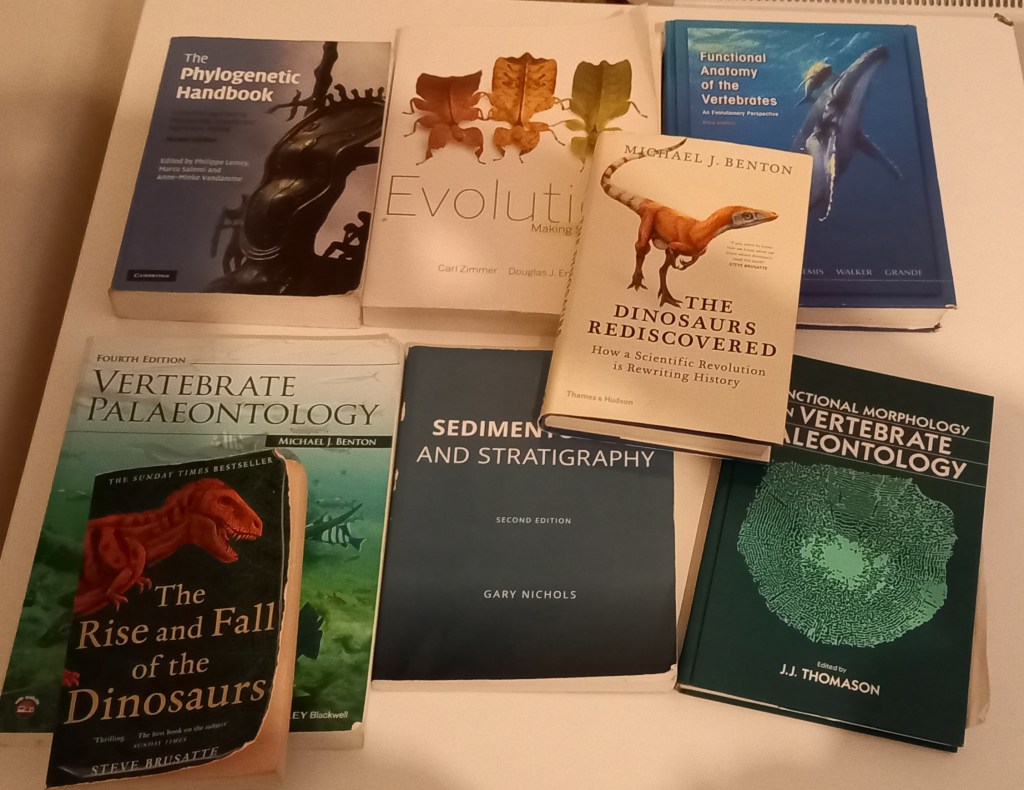
I would not wish that situation on anyone though. I was under a lot of pressure. It was not a pleasant situation to be in. Amazingly, my exam pass marks in my resits were much higher than my Geography degree pass marks! I really revised like crazy and was determined to finish the whole course. I was so happy when I got my final course marks in July, that I passed the course. I worked so hard, I felt vindicated!
I knew going back to palaeo as a career was meant to be when I got accepted on the MSc course the 2nd time. I knew deep down that it was achievable for me, despite what my careers advisor said many years ago. The Palaeobiology MSc at Bristol Uni was very enjoyable.
The Palaeobiology Research Group is incredibly supportive, all the lecturers were really helpful and passionate about the subject. I highly recommend the course to anyone thinking of studying palaeontology in the UK. I thoroughly enjoyed all the modules I studied, which I have listed here below:
EASCM1016 – Thesis- How did hadrosaurs use their amazing dentitions to cement such a successful radiation in the Late Cretaceous? (MSc in Palaeobiology)
EASCM0001- Current Controversies in Palaeobiology and Macroevolution
EASCM0034- Literature Review
EASCM0035- Phylogenetic Methods in Palaeobiology
EASCM0038- Research Methods in Palaeobiology
EASCM0037- Geology for Research Palaeobiologists
EASCM0055- Advanced Vertebrate Palaeobiology and Biomechanics
EASC30052- The Cambrian Explosion – the origin of animal body plans
BIOL20212- Evolutionary Biology
My academic palaeontology career story so far has been very up and down. It has been a lot of hard work and stressful in parts, but I am happy to be where I am now with a full MSc qualification in the subject. I still have a lot of work to do to get into the career I want to get into, but I hope my story has managed to inspire you and give you some hope. Never give up on your dreams!
If you work hard enough you can get to where you want to be. Perseverance is key and going at your own pace is as well. Knowing when to take a break and come back, knowing when things are too much.
You have to make the right decision for you when it comes to academic study. There are many different ways into palaeontology, your career trajectory won’t be a straight line and it won’t be easy, but that does not mean it will not be achievable!
Do GCSE and A-Level Grades Matter?
Do grades matter early on in terms of GCSEs and A-Levels? In some regards I would say yes, as the early study gives you formation in those subjects that are core components of palaeontology such as Biology and Geology.
My journey is unique but if you want to make things as easy as possible, you will want to prioritise the subjects that are key components of palaeontology most notably Biology, Geology and Maths.
If I had a chance to re-do my GCSEs and A-Levels with all the support I needed, I would most likely prioritise Science, so Biology. I would also do a Geology GCSE (although not many colleges do these anymore) or Geography.
A-Levels again would be science focused with Geology and Biology A-Levels. Again, Maths would be handy, I struggle with Maths but to those out there who are good at Maths, Maths is quite important especially as most modern palaeontology is computer based.
Ultimately you want to give yourself the best possible chance of getting onto palaeontology degree/master programme by choosing the relevant subjects. It will not only give you a good starting formation but will tick the boxes of the Universities wanting that evidence of study later.
I would say gaining experience through Museum volunteering, collection cataloguing and taking part in fieldwork is just as important. Helping you not only to network and make connections but build up necessary experience alongside your studies, putting what you have learnt into practice.
Is a Career in Palaeontology Achievable?
I would say eventually, yes but it will depend on what you want to do. For the career I want to go into I do not necessarily need to have a PHD. I already have a game plan of experience I want to build up going forward. Palaeontology is well known for being incredibly competitive, lack of jobs, the pay is not great etc.
But it all comes down to passion and work ethic, building connections, building experience, and taking opportunities as and when they come. Going forward, I am not particularly worried about the job prospects. I know what to expect. I know how hard I work, and I know that I will eventually get to where I want to be, because I have made it this far so far.
For anyone wanting to find out more about the different routes into palaeontology, I would really recommend listening to the below episode from Dr. David Hone on the Terrible Lizards Podcast on the different routes into palaeontology. It is well worth listening to! Dave goes into more depth about the subjects young people should take to give themselves the best opportunity of studying palaeontology.

TLS07E06 Working with dinosaurs – Terrible Lizards
2024 Update
So since I wrote this I have no only built up more science communication experience but I also went out to Montana in June to do palaeontological fieldwork. You can learn more about this at the fieldwork page. Visiting Montana was another life goal of mine and I achieved it! I hope this is inspiring as you can achieve anything if you work hard enough and persevere.
Feel free to share this article and give the website a follow to keep up to date with my latest blog posts. If you have any questions about my academic journey feel free to reach out to me via my contact page! Or comment below.

Support the Science. Join the Expedition. Explore deep time with every dispatch. Subscribe to The Palaeo Minute newsletter and be part of the fossil journey.