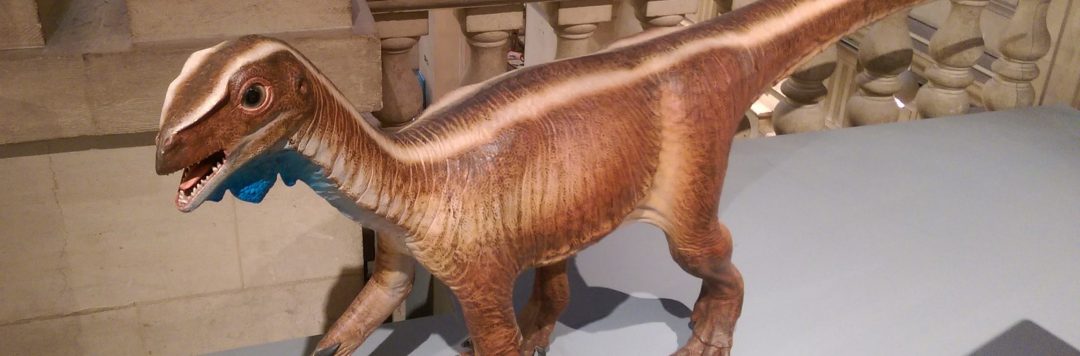
On the 14th of December 2020 new research was published in the Journal of the Linnean Society on the brain analysis of the Bristol Dinosaur, Thecodontosaurus antiquus. In this article I give an overview of the research from the palaeontologists at The University of Bristol.
I thought what better way to start 2021 off then to cover the mascot of The Bristol Dinosaur Project with new research from the University of Bristol on the sauropodomorph Thecodontosaurus antiquus. I have covered sauropodomorphs before on the website when I wrote about the discovery of Macrocollum itaquii back in 2018 and the early Jurassic dinosaur Mussaurus patagonicus in 2019.
What was Thecodontosaurus
Thecodontosaurus name means (“socket-toothed lizard”) the dinosaur was a basal sauropodomorph that lived during the Late Triassic (the Rhaetian age) some 203-201 million years ago. Thecodontosaurus was a relatively small dinosaur, being about a foot high and reaching a length of just over 6 feet. Thecodontosaurus has had an interesting history with its remains being discovered back in 1834 at the quarry of Durdham Down in Clifton, an area in Bristol I know fairly well.
Thecodontosaurus was one of the first dinosaurs to be discovered and its fossilised remains have seen much research at the University of Bristol over the years courtesy of Bristol Museum. I was fortunate enough last year on my MSc Palaeobiology course to have the chance to see some of the Thecodontosaurus fossil material that Bristol University has available, which was really exciting to see!

What was the research?
On the 14th December 2020 new research on Thecodontosaurus was published by PHD student Antonio Ballell and co-authors examining the brain case and inner ear of Theco (YPM 2192) through digital imaging and 3D modelling techniques. Many News and Science websites quickly picked up the research about the famous Bristol Dinosaur with SKY News, BBC News, Science News and many others sharing the important work that had been undertaken to understand this dinosaurs history.
The results showed that Thecodontosaurus was bipedal walking on two legs unlike its later relatives that were quadrupedal, who walked on all fours. This was measured through the analysis of the floccular lobes at the back of Thecodontosaurus brain. These lobes are large suggesting that this dinosaur was agile, that it was able to keep its eyes and head steady when moving.
Possible evidence was found that this might have enabled Thecodontosaurus to be an occasional omnivorous feeder. The results of the study also imply that this dinosaur had an acute hearing frequency compared to other sauropodomorph taxa, suggesting Thecodontosaurus had some social complexity (Ballell et al. 2020). The research has enabled a greater insight into the evolution of sauropodomorph braincases and the palaeobiology of Thecodontosaurus.

This research has been integral in finding out more about the palaeobiology of Thecodontosaurus along with braincase and endocranial evolution within the Sauropodomorpha. I hope this breakdown of the research has been helpful. If you have enjoyed reading this article do give the website a follow, to keep up to date with my latest blog posts.
You can find out more about my palaeontology research at the research page. You can also check out all my science communication outreach at the scicomm links page.

